
Langfuse
Open-source LLM tracing, evals and prompt management, hosted or self-hosted
Our verdict
#1 of 9 in LLM observability tools · Best all-round pick for most teams
What it does
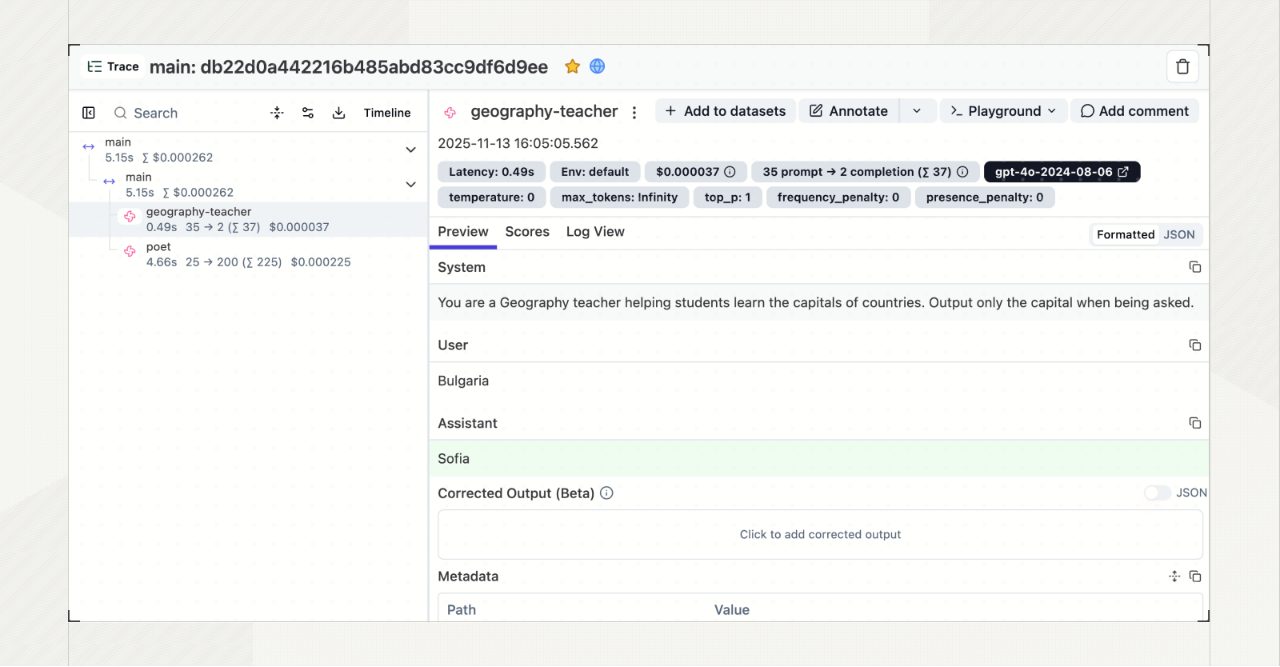
- Traces with agent graphs, sessions and user tracking
- Datasets, experiments, LLM-as-a-judge and annotation queues
- Versioned prompts with labels and a playground
- Cost dashboards and alerts
Pros
- Same MIT-licensed code in the cloud and self-hosted, with no core features held back
- Works with nearly every framework through OpenTelemetry and native integrations
- Core plan includes unlimited users
Cons
- Turning evals into CI gates is left to you
- Every span and score counts as a billable unit on the cloud plans
- Self-hosting needs ClickHouse, Postgres, Redis and object storage
- Skip if:
- Your agent is all LangGraph and you want the view built for it
Langfuse is an open-source platform for tracing, evaluating and managing prompts in LLM apps and agents. It records each model call, tool call and retrieval step as a trace, tracks token cost and latency, and runs datasets, experiments, LLM-as-a-judge evaluators and human annotation queues. It is built on OpenTelemetry and has SDKs for Python and JavaScript plus integrations for most agent frameworks. Teams use Langfuse Cloud, which has a free tier, or self-host the MIT-licensed core with Postgres, ClickHouse, Redis and S3-compatible storage; a paid license key adds enterprise security features. ClickHouse acquired Langfuse in January 2026.
What users say
Evidence ↓One comparison author running a few million spans a month rates Langfuse a safe long-term pick for teams that want control of their data, but finds that its evaluation building blocks leave teams to assemble regression suites, CI gates and drift alerts themselves.
Rankings and alternatives
- LLM observability tools #1 of 9 Best all-round pick for most teams
- Opik #2 Cheapest hosted plan, fully Apache 2.0
- Pydantic Logfire #3 For Python teams who want one observability tool
- LangSmith #4 For LangChain and LangGraph apps




LLM observability tools scores
Evaluated Nov 17, 2026 Evidence ↓- Agent tracing and debugging 4
4/5 means: Nested traces plus sessions or threads, agent graph views and filtering or search across traces
Nested traces of model, tool and retrieval steps with agent graphs, session and user tracking, and filtering across traces, on every plan. A capable, well-liked trace view, but practitioners single out LangSmith and Phoenix for the deepest agent-specific views.
- Evaluations and regression testing 4
4/5 means: Datasets, experiments, LLM-as-a-judge scoring of production traces and human annotation, with CI use possible through the SDK
Datasets, experiments from the SDK and UI, LLM-as-a-judge evaluators on production traces, annotation queues and user feedback. One comparison author notes regression suites and CI gates are left for the team to build.
- Framework-neutral setup 5
5/5 means: Built on OpenTelemetry, with integrations for nearly every major model SDK and agent framework and equal support whatever framework you use
Built on OpenTelemetry, with Python and JavaScript SDKs and native integrations for OpenAI, LangChain and LangGraph, LlamaIndex, the Vercel AI SDK, the OpenAI Agents SDK, the Claude Agent SDK, Pydantic AI and many more.
- Cost, latency and production monitoring 4
4/5 means: Cost and latency dashboards, custom charts and alerts to email, Slack or webhooks
Token and cost tracking, custom dashboards and alerts are on every plan (2 alerts on Hobby, 20 on Core). It is not a general monitoring platform, so app and infrastructure metrics live elsewhere.
- Hosted service for a small team 4
4/5 means: Hosted with a free plan a small team can work in, then a paid plan under about $50 a month with usage-based overage
Free Hobby plan with 50k units and 2 users, then Core at $29 a month with unlimited users and $8 per 100k units. Every observation and score counts as a unit, so agent traffic uses the allowance quickly.
- Self-hosting · counts half 5
5/5 means: Free self-hosting of the full product under an open-source license, with only enterprise administration features paid
MIT-licensed core with all core features and no usage limits, same codebase as the cloud; a license key only adds enterprise features such as SCIM, audit logs and retention policies. Needs Postgres, ClickHouse, Redis and S3.
- Prompt management and playground · counts half 5
5/5 means: Versioned prompts with release labels, a playground that replays traced calls, and prompt experiments against datasets
Versioned prompts with release labels and caching, a playground you can open from a traced generation, and prompt experiments against datasets.
Pricing
- Hobby Free
- Core $29.00/month
- Pro $199.00/month
- Self-hosted (OSS) Free
Prices checked Nov 17, 2026.
Evidence and sources
What users say
Summary 1 quote
-
Langfuse. LLM-as-a-judge and custom scorer primitives. Ships the runtime. The orchestration layer is DIY: regression suites, CI gates, drift alerts. Good if you want control. Tedious if you want batteries.
Gabriel Anhaia, author of a book on LLM observability, comparing four platforms on his own app's workload of about 2M spans a month · dev.to/gabrielanhaia/langfuse-vs-langsmith-vs-phoenix-vs-braintrust-the-honest-2026-comparison-253p · published · checked
LLM observability tools scores
Agent tracing and debugging 1 quote
-
Langfuse is built on OpenTelemetry, so any OpenTelemetry-instrumented application, framework, or collector can send traces to Langfuse.
github.com/langfuse/langfuse · checked
Evaluations and regression testing 2 quotes
-
It supports LLM-as-a-judge, code evaluators, user feedback collection, manual labeling, and custom evaluation pipelines via APIs/SDKs. Use Datasets and Experiments to build test sets and benchmarks for pre-deployment testing and continuous improvement.
github.com/langfuse/langfuse · checked -
Langfuse. LLM-as-a-judge and custom scorer primitives. Ships the runtime. The orchestration layer is DIY: regression suites, CI gates, drift alerts. Good if you want control. Tedious if you want batteries.
Gabriel Anhaia, author of a book on LLM observability, comparing four platforms on his own app's workload of about 2M spans a month · dev.to/gabrielanhaia/langfuse-vs-langsmith-vs-phoenix-vs-braintrust-the-honest-2026-comparison-253p · published · checked
Framework-neutral setup 1 quote
-
Langfuse is built on OpenTelemetry, so any OpenTelemetry-instrumented application, framework, or collector can send traces to Langfuse.
github.com/langfuse/langfuse · checked
Cost, latency and production monitoring 1 quote
-
Everything in Hobby 100k units / month included, additional: $8/100k units. Lower with volume (pricing calculator) 90 days data access Unlimited users In-app support
langfuse.com/pricing · checked
Hosted service for a small team 3 quotes
-
All platform features (with limits) 50k units / month included 30 days data access 2 users Community support via GitHub
langfuse.com/pricing · checked -
Everything in Hobby 100k units / month included, additional: $8/100k units. Lower with volume (pricing calculator) 90 days data access Unlimited users In-app support
langfuse.com/pricing · checked -
A billable unit in Langfuse is any tracing data point you send to our platform — this includes the trace (a complete application interaction), observations (individual steps within a trace: Spans, Events and Generations), and scores (evaluations of your AI outputs).
langfuse.com/pricing · checked
Self-hosting 2 quotes
-
All core Langfuse features and APIs are available in Langfuse OSS (MIT licensed) without any limits.
langfuse.com/self-hosting/license-key · checked -
Storage Components: Postgres: The main database for transactional workloads. Clickhouse: High-performance OLAP database which stores traces, observations, and scores. Redis/Valkey cache: A fast in-memory data structure store. Used for queue and cache operations. S3/Blob Store: Object storage to persist all incoming events, multi-modal inputs, and large exports.
langfuse.com/self-hosting · checked
Facts
License 1 quote
-
All core Langfuse features and APIs are available in Langfuse OSS (MIT licensed) without any limits.
langfuse.com/self-hosting/license-key · checked
Runs on 2 quotes
-
Yes, Langfuse is open source and you can self-host Langfuse for free. Use docker compose to run Langfuse locally, or use one of our templates to self-host Langfuse in production on Kubernetes.
langfuse.com/pricing · checked -
Storage Components: Postgres: The main database for transactional workloads. Clickhouse: High-performance OLAP database which stores traces, observations, and scores. Redis/Valkey cache: A fast in-memory data structure store. Used for queue and cache operations. S3/Blob Store: Object storage to persist all incoming events, multi-modal inputs, and large exports.
langfuse.com/self-hosting · checked
Needs 1 quote
-
Storage Components: Postgres: The main database for transactional workloads. Clickhouse: High-performance OLAP database which stores traces, observations, and scores. Redis/Valkey cache: A fast in-memory data structure store. Used for queue and cache operations. S3/Blob Store: Object storage to persist all incoming events, multi-modal inputs, and large exports.
langfuse.com/self-hosting · checked
Users 1 quote
-
Langfuse OSS and Enterprise use the same codebase as Langfuse Cloud. Langfuse processes 110B+ observations per month and is trusted by 21 of the Fortune 50. Its Docker images have been pulled 38M+ times.
langfuse.com/self-hosting · checked
More from the sources
Features 1 quote
-
Langfuse stays open source and self‑hostable. There are no planned changes to licensing. As you know, we leaned heavily into OSS over the last years.
langfuse.com/blog/joining-clickhouse · checked
Pricing
langfuse.com/pricing · checked