
ResearchRabbit
Citation-network literature discovery that maps papers from your seed papers, with no AI-written answers
Our verdict
#8 of 9 in AI research assistants for academic papers · For mapping citations from papers you already have
What it does
- Similar papers, references, citations, and authors from your seed papers
- A citation map you can rearrange
- Shared collections
- Zotero import, with two-way sync on RR+
- Alerts and a retraction filter on RR+
Pros
- No generated text to fact-check
- Unlimited searches and collections for free
- Turns a few known papers into a reading list quickly
Cons
- Finds only papers connected to your seeds
- The retraction filter and alerts are paid
- No summaries or answers
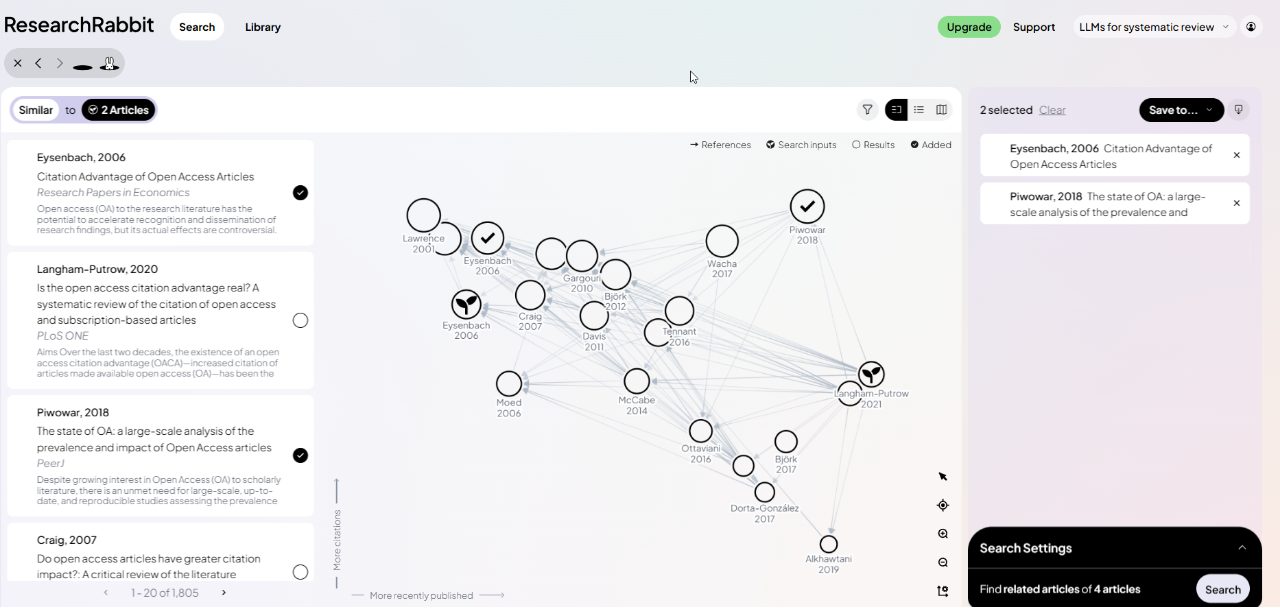
ResearchRabbit is a web app for finding and mapping academic papers from seed papers you choose. It recommends real papers from the citation graph (references, citations, similar work and authors) and draws them on a citation map, rather than writing answers or summaries; the vendor says it does not use large language models for its core recommendations. It draws on Crossref, Semantic Scholar and OpenAlex. A free plan allows up to 50 seed papers; the paid ResearchRabbit+ plan raises that to 300 and adds filters, multiple projects and alerts. It relaunched in October 2025 with a new app and its first paid plan, and is run with Litmaps, the sister product from Litmap Limited, which the vendor calls a partnership and press reported as an acquisition.
What users say
Evidence ↓The practitioner account found is a single librarian's walkthrough of the 2025 relaunch. He found the new interface an improvement and easier to understand than Litmaps, though less functional, and calls it a user-friendly entry to iterative citation chaining. He found the "rabbit hole" checkpoint metaphor unintuitive and regretted that retraction filtering sits behind the paywall. One person's view, not a sample of users.
Rankings and alternatives
- AI research assistants for academic papers #8 of 9 For mapping citations from papers you already have
- Elicit #1 Best for literature and systematic reviews
- Semantic Scholar #2 Free AI search and summaries from a nonprofit
- Undermind #3 For not missing a paper



AI research assistants for academic papers scores
Evaluated Nov 17, 2026 Evidence ↓- Finding the papers that matter · counts double 3
3/5 means: A solid single search, keyword or semantic, that finds well-known papers but misses many that use other words
Recommends papers from seed papers by citations, references, co-citation, co-authorship and (per a librarian's inference) title/abstract similarity, iterated over a growing seed set. It does not judge each paper's relevance, and no recall test was found, and it only surfaces papers connected to your seeds, so 3 rather than 4.
- Answers you can check · counts double unknown
It lists real papers from the citation graph and makes no claims or summaries about their content (no LLM in core recommendations, no chat), so the criterion does not apply.
- Answers and reports 1
1/5 means: No written answer; it only lists or maps papers
No written answer or report; it only lists and maps papers.
- Coverage and full-text reading 3
3/5 means: A scholarly index of about 100 million papers or more, read mainly from titles and abstracts
Index of 310M+ articles from Crossref, Semantic Scholar and OpenAlex, working from metadata and abstracts with no full-text reading; papers with closed metadata have missing links. Vendor pages quote 280M, 310M+ and 320M+.
- What the free plan covers 4
4/5 means: Free with no published limit on the main features, but with paid extras or a daily cap on the AI part
Free has unlimited searches, unlimited collections and sharing, with no monthly cap, but 50 seed papers, one project and no advanced filters (including retraction filtering); alerts and the larger seed cap are paid. It has no AI answers or chat to limit.
- Citation chasing and alerts 5
5/5 means: Built around it, with seed-paper collections, citation maps and alerts on new papers
Built around it, with seed-paper collections, citation maps, similar/references/citations/author modes and alerts on new papers; alerts are RR+ only (per a secondary summary of the Nov 2026 release).
- Screening and data extraction 2
2/5 means: Bulk export of results or collections, but no screening or extraction
Bulk import and BibTeX export of collections, but no screening, extraction or audit trail; a reviewer says it is not a systematic search and a librarian points to citationchaser for transparent review use. RIS and CSV export were not confirmed.
- Working with your own papers · counts half 3
3/5 means: Two of upload and chat, reference-manager import or sync, and citation export
Reference-manager import and sync (free one-way Zotero importer, two-way sync on RR+, which is the cheapest paid plan) plus BibTeX export; no PDF upload or chat found.
Pricing
- Free Free Unlimited searches and unlimited library and collections, collaboration by sharing a collection, up to 50 seed articles and core search settings. One project per account; advanced search filters (including excluding retractions) are not included.
- ResearchRabbit+ (annual billing) $10.00 /month Price per month when paying annually, as read by a third-party review; the vendor's own FAQ describes monthly payments and the billing commitment is ambiguous on the vendor page, so confirm at checkout. Up to 300 seed articles, advanced search controls, multiple projects, Signals alerts and faster support. Per a third-party summary of the November 2026 release, also filters, Analyze tab, Project Alerts for new papers and two-way Zotero sync. Country discount codes for 100+ countries; no student-specific price found.
- ResearchRabbit+ (monthly billing) $12.50 /month Month-to-month price shown on the pricing card, per a third-party review of the toggle.
- Institution Contact sales Contact sales. Adds volume discounts, LibKey integration, user management and usage statistics.
Prices checked Nov 17, 2026.
Evidence and sources
What users say
Summary 3 quotes
-
Overall, the newer ResearchRabbit seems to be an improvement over the original, with a less crowded and messy interface. Also, you can see the obvious, heavy influence of the partnership with Litmaps. However, in my opinion, ResearchRabbit’s interface is easier to understand, though it may have less functionality.
Aaron Tay, academic librarian who writes on literature discovery tools · aarontay.substack.com/p/researchrabbits-2025-revamp-iterative · published · checked -
That said, the “rabbit hole” interface and its metaphor are not as intuitive as they could be, and it took me a while to figure out what triggered a “rabbit hole” creation versus what did not.
Aaron Tay, academic librarian who writes on literature discovery tools · aarontay.substack.com/p/researchrabbits-2025-revamp-iterative · published · checked -
I understand the need for ResearchRabbit to earn revenue, still, it would have been nice if ResearchRabbit gave free users the ability to filter out retractions, as this seems like a critical feature to improve research.
Aaron Tay, academic librarian who writes on literature discovery tools · aarontay.substack.com/p/researchrabbits-2025-revamp-iterative · published · checked
AI research assistants for academic papers scores
Finding the papers that matter 4 quotes
-
ResearchRabbit uses network-based algorithms to understand how papers relate to one another across the research network, based on first-degree and second-degree connections.
learn.researchrabbit.ai/en/articles/13545485-how-researchrabbit-uses-ai-and-where-we-don-t · checked -
The company now “partners’ with Litmaps (others are reporting as acquired, which shows up in features and business model
Aaron Tay, academic librarian who writes on literature discovery tools · aarontay.substack.com/p/researchrabbits-2025-revamp-iterative · published · checked -
IMHO RR is now a user friendly entry to iterative citation chaining; Litmaps still leads on advanced visualization/filters methods; Connected Papers remains the fastest and easiest to use “single-seed” map.
Aaron Tay, academic librarian who writes on literature discovery tools · aarontay.substack.com/p/researchrabbits-2025-revamp-iterative · published · checked -
This is also why Research Rabbit is a discovery tool and not a systematic search. It finds what is connected to your seeds. A paper in your topic that nobody in your seed network has cited will not surface, however relevant it is.
aitoolsbakery.com/blog/research-rabbit-review · published · checked
Answers you can check 1 quote
-
ResearchRabbit does not use large language models to power its core recommendation algorithms.
learn.researchrabbit.ai/en/articles/13545485-how-researchrabbit-uses-ai-and-where-we-don-t · checked
Answers and reports 1 quote
-
ResearchRabbit does not use large language models to power its core recommendation algorithms.
learn.researchrabbit.ai/en/articles/13545485-how-researchrabbit-uses-ai-and-where-we-don-t · checked
Coverage and full-text reading 2 quotes
-
Unlimited searches across 310+ million articles
researchrabbit.ai/pricing · checked -
From three providers: Crossref, Semantic Scholar and OpenAlex, refreshed weekly. It can only index papers with openly available metadata, so some references and citations, especially for new or paywalled papers, can be missing.
aitoolsbakery.com/blog/research-rabbit-review · published · checked
What the free plan covers 6 quotes
-
Unlimited searches across 310+ million articles
researchrabbit.ai/pricing · checked -
Unlimited library and collections
researchrabbit.ai/pricing · checked -
Use up to 50 seed articles
researchrabbit.ai/pricing · checked -
Use up to 300 seed articles for large scale reviews
researchrabbit.ai/pricing · checked -
I understand the need for ResearchRabbit to earn revenue, still, it would have been nice if ResearchRabbit gave free users the ability to filter out retractions, as this seems like a critical feature to improve research.
Aaron Tay, academic librarian who writes on literature discovery tools · aarontay.substack.com/p/researchrabbits-2025-revamp-iterative · published · checked -
The 5 November release added more to RR+: an Analyze tab for spotting where topics overlap and how that overlap has grown, a Filter panel covering keywords, publication date, journal quality, retractions and open access, Project Alerts for new papers that build on your library, and two-way Zotero sync.
aitoolsbakery.com/blog/research-rabbit-review · published · checked
Citation chasing and alerts 4 quotes
-
Advanced search controls for faster discovery
researchrabbit.ai/pricing · checked -
ResearchRabbit uses network-based algorithms to understand how papers relate to one another across the research network, based on first-degree and second-degree connections.
learn.researchrabbit.ai/en/articles/13545485-how-researchrabbit-uses-ai-and-where-we-don-t · checked -
Firstly, the visualization has been completely revamped. By default, papers are displayed as nodes, with the x-axis representing the publication year and the y-axis representing citation count. Arrows indicate the direction of citations.
Aaron Tay, academic librarian who writes on literature discovery tools · aarontay.substack.com/p/researchrabbits-2025-revamp-iterative · published · checked -
The 5 November release added more to RR+: an Analyze tab for spotting where topics overlap and how that overlap has grown, a Filter panel covering keywords, publication date, journal quality, retractions and open access, Project Alerts for new papers that build on your library, and two-way Zotero sync.
aitoolsbakery.com/blog/research-rabbit-review · published · checked
Screening and data extraction 3 quotes
-
Of course, for the most transparent tool for systematic review use , the free citationchaser is by far the most popular.
Aaron Tay, academic librarian who writes on literature discovery tools · aarontay.substack.com/p/researchrabbits-2025-revamp-iterative · published · checked -
The free tier help article, updated in May 2026, lists what stays free: article search from up to 50 starting papers, browsing of citations, references and similar work, citation maps, collections and subcollections, the Zotero Importer, shared collections and public links, BibTeX import and export, and notes, stickers and colours.
aitoolsbakery.com/blog/research-rabbit-review · published · checked -
This is also why Research Rabbit is a discovery tool and not a systematic search. It finds what is connected to your seeds. A paper in your topic that nobody in your seed network has cited will not surface, however relevant it is.
aitoolsbakery.com/blog/research-rabbit-review · published · checked
Working with your own papers 3 quotes
-
The older ResearchRabbit had a two-way sync with Zotero folders; as of this writing, that feature isn’t yet available in the new version.
Aaron Tay, academic librarian who writes on literature discovery tools · aarontay.substack.com/p/researchrabbits-2025-revamp-iterative · published · checked -
The 5 November release added more to RR+: an Analyze tab for spotting where topics overlap and how that overlap has grown, a Filter panel covering keywords, publication date, journal quality, retractions and open access, Project Alerts for new papers that build on your library, and two-way Zotero sync.
aitoolsbakery.com/blog/research-rabbit-review · published · checked -
The free tier help article, updated in May 2026, lists what stays free: article search from up to 50 starting papers, browsing of citations, references and similar work, citation maps, collections and subcollections, the Zotero Importer, shared collections and public links, BibTeX import and export, and notes, stickers and colours.
aitoolsbakery.com/blog/research-rabbit-review · published · checked
Facts
Runs on 1 quote
-
Unlimited searches across 310+ million articles
researchrabbit.ai/pricing · checked
More from the sources
Pricing 2 quotes
-
The default pricing (which U.S., UK, Canada and other countries fit under) is USD$10 per month. For 100+ countries, RR+ is discounted based on your country's parity group.
researchrabbit.ai/pricing · checked -
RR+ was $10 a month on the annual plan and $12.50 a month on the monthly plan when we read the price toggle on 10 November 2026. The pricing card lists up to 300 seed articles, advanced search controls, multiple projects, Signals alerts, which flag high-risk papers based on their citation behaviour, and faster support.
aitoolsbakery.com/blog/research-rabbit-review · published · checked
Features 3 quotes
-
Thanks to our partnership with Litmaps, ResearchRabbit is now faster, more flexible, and more powerful than ever before.
researchrabbit.ai/releases/welcome-to-the-new-researchrabbit · checked -
Every page on researchrabbit.ai carries a copyright footer naming Litmap Limited. Litmap Limited is the New Zealand company behind Litmaps, a competing literature mapping tool.
aitoolsbakery.com/blog/research-rabbit-review · published · checked -
Connected Papers builds one similarity graph around one paper and gives 5 free graphs a month, with Academic plans from USD 3 a month billed annually. Research Rabbit builds from many seeds, keeps collections and has no monthly search cap on the free plan.
aitoolsbakery.com/blog/research-rabbit-review · published · checked
Limits and known issues 1 quote
-
On data, Research Rabbit’s data summary states “We don’t train AI models using your articles or notes” and that it does not sell or expose your articles or notes to third parties.
aitoolsbakery.com/blog/research-rabbit-review · published · checked
Pricing
researchrabbit.ai/pricing · checked