Google Agent Development Kit
Google's open-source, code-first framework for building agents, with graph workflows in ADK 2.0
 (opens full size in a new tab)
Facts
- Price
- Free plan
- Runs on
- PythonTypeScriptGoJava
- Needs
- Python 3.11 or later (Python edition)
- License
- Apache License 2.0, open source
- Category
- AI
- Facts checked
Price checked · Current prices on cloud.google.com ↗
Our verdict
#7 of 10 in AI agent frameworks
Gemini and Google Cloud teams
What it does
- Graph workflows with routing, loops, retries, and human approvals
- Sub-agents, task delegation, and A2A
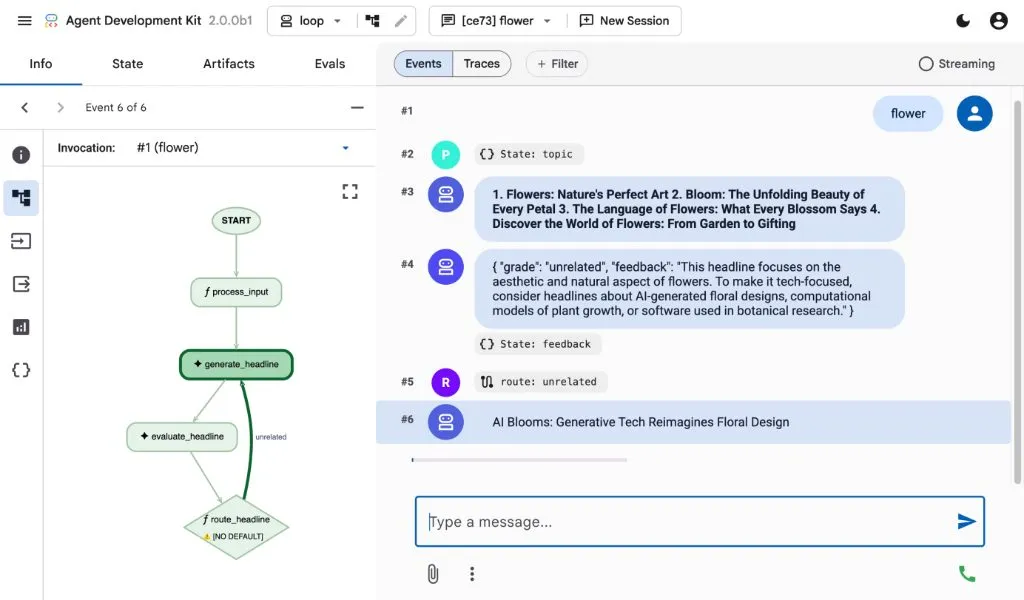
- Local dev UI with graph view, state, traces, and evals
- Python, TypeScript, Go, and Java editions
Pros
- Widest language support
- Strong free debugger
- Rich multi-agent patterns
Cons
- Tuned for Gemini; other models go through a wrapper
- The last major upgrade broke existing agents in places
- Easiest deployment path is Google Cloud
- Choose if:
- You build on Gemini, or your team writes Go or Java
About Google Agent Development Kit
Agent Development Kit (ADK) is Google’s open-source framework for building, evaluating and deploying LLM agents in code. Version 2.0 adds a graph-based Workflow Runtime with routing, fan-out and fan-in, loops, retries and human-in-the-loop pauses, alongside sub-agent hierarchies and a Task API for agent delegation. It is released under Apache 2.0 and ships for Python, TypeScript and Go, with a Java edition as well. It is optimized for Gemini but can use other models through LiteLLM and similar wrappers. It includes a local dev UI (adk web), and agents can be deployed with Docker, Cloud Run or Google’s paid Agent Runtime.
What users say
Little practitioner commentary was found. One blogger who covered the 2.0 release sees the new Workflow Runtime as a direct competitor to LangGraph, but says teams outside Google Cloud will still find LangGraph's ecosystem more mature. The same post warned about storage incompatibility between 1.x and 2.0, which Google's current docs describe more narrowly. This is a single source, not a broad sample.
2 quotes from users and reviewers
If you're not on Google Cloud, LangGraph still has a more mature ecosystem and the new A2A Task API in ADK 2.0 doesn't change that calculus much.
Peyton Green, DEV Community blogger · dev.to/peytongreen_dev/google-adk-20-is-now-stable-workflow-runtimes-breaking-changes-and-how-to-migrate-4ah8 · published · checked Do not use ADK 2.0 storage with ADK 1.x databases. This isn't a "things might break" warning — Google explicitly flags this as data loss territory.
Peyton Green, DEV Community blogger · dev.to/peytongreen_dev/google-adk-20-is-now-stable-workflow-runtimes-breaking-changes-and-how-to-migrate-4ah8 · published · checked
Ranked in
-
#7 of 10 AI agent frameworks Gemini and Google Cloud teams 3.7/5
How it scored
-
Control over flow and state , counts double 4/5
The free library has a graph Workflow Runtime with routing, loops, retries, state management and human-in-the-loop pauses, plus saved sessions. It is unclear whether it resumes after a crash at every step or rewinds state, so not 5.
4/5 means: A workflow or graph engine in the free library with saved state, pause and resume, and human approvals
The ADK 2.0 release introduces the Workflow Runtime, transitioning ADK from a hierarchical agent executor to a graph-based execution engine. In this new architecture, your Agents, Tools, and Functions are evaluated as individual nodes within a workflow graph.
adk.dev/2.0 · checked Workflow Runtime: A graph-based execution engine for composing deterministic execution flows for agentic apps, with support for routing, fan-out/fan-in, loops, retry, state management, dynamic nodes, human-in-the-loop, and nested workflows.
github.com/google/adk-python · checked
-
Production track record and API stability 3/5
Stable 2.x under Apache 2.0, actively maintained by Google with roughly bi-weekly releases, but 2.0 (May 2026 for Python) was a recent rewrite with breaking changes, and TypeScript only reached 2.0 in August 2026. Named production users were not researched.
3/5 means: Usable in production, but upgrades break things often, through pre-1.0 releases, a recent major rewrite, or a maker whose focus has moved elsewhere
ADK 2.0 is designed to be compatible with agents developed with ADK 1.x releases. However, there are a few breaking changes you should be aware of before upgrading an ADK 1.x project to ADK 2.0.
adk.dev/2.0 · checked Custom overrides of 1.x abstract methods, such as _run_async_impl() or generate_content(), are no longer the correct way to drive execution. The Workflow Graph engine completely bypasses these legacy overrides. If you inject custom telemetry or state management by overriding these methods, those calls are silently ignored.
adk.dev/2.0 · checked ADK Go 2.0 uses a new major version module path. You must update all import paths in your Go source files and your go.mod file.
adk.dev/2.0 · checked Requirements: Python 3.11+.
github.com/google/adk-python · checked
Show all 4
-
Tracing and debugging 4/5
A free local dev UI (
adk web) shows events, state, graph and a Traces tab, and ADK emits OpenTelemetry traces. It has no rewind, so not 5.4/5 means: Built-in tracing to the backend you choose, plus a visual debugger or trace viewer, local or from the maker, usable without a paid plan
A built-in development UI to help you test, evaluate, debug, and showcase your agent(s).
github.com/google/adk-python · checked
-
Freedom to switch model providers 3/5
Model-agnostic but optimized for Gemini; non-Gemini models go through LiteLLM or Apigee wrapper classes, with model routing and failover documented. How well non-Gemini models work was not verified.
3/5 means: Model-agnostic, but tuned for one maker's models or cloud, with other providers through a generic wrapper
While optimized for Gemini, ADK is model-agnostic, deployment-agnostic, and compatible with other frameworks.
github.com/google/adk-python · checked Model connectors: For broader compatibility, especially models outside the Google ecosystem or those requiring specific client configurations, such as models accessed via Apigee or LiteLLM. You instantiate a specific wrapper class, such as ApigeeLlm or LiteLlm, and pass this object as the model parameter to your LlmAgent.
adk.dev/agents/models · checked
-
Multi-agent support 5/5
Sub-agent hierarchies, graph workflows with fan-out and fan-in, a Task API and coordinator patterns are documented. A2A protocol support is reported in one blog post.
5/5 means: Everything in 4, plus A2A support so agents can work with agents in other frameworks or services
ADK 2.0 is available for Python, TypeScript, and Go, and includes the following key features:
adk.dev/2.0 · checked Workflow Runtime: A graph-based execution engine for composing deterministic execution flows for agentic apps, with support for routing, fan-out/fan-in, loops, retry, state management, dynamic nodes, human-in-the-loop, and nested workflows.
github.com/google/adk-python · checked Task API: Structured agent-to-agent delegation with multi-turn task mode, single-turn controlled output, mixed delegation patterns, human-in-the-loop, and task agents as workflow nodes.
github.com/google/adk-python · checked If you're not on Google Cloud, LangGraph still has a more mature ecosystem and the new A2A Task API in ADK 2.0 doesn't change that calculus much.
Peyton Green, DEV Community blogger · dev.to/peytongreen_dev/google-adk-20-is-now-stable-workflow-runtimes-breaking-changes-and-how-to-migrate-4ah8 · published · checked
Show all 4
-
Learning curve and everyday developer experience 3/5
Short quick-start code and a dev UI make a first agent fast, but the 2.0 migration and API churn add friction. Little practitioner commentary was found, so the level is a judgment.
3/5 means: Takes days to learn, or is quick to start but harder to change and debug as the agent grows; practitioners' reports are mixed
ADK 2.0 is designed to be compatible with agents developed with ADK 1.x releases. However, there are a few breaking changes you should be aware of before upgrading an ADK 1.x project to ADK 2.0.
adk.dev/2.0 · checked Custom overrides of 1.x abstract methods, such as _run_async_impl() or generate_content(), are no longer the correct way to drive execution. The Workflow Graph engine completely bypasses these legacy overrides. If you inject custom telemetry or state management by overriding these methods, those calls are silently ignored.
adk.dev/2.0 · checked If you're not on Google Cloud, LangGraph still has a more mature ecosystem and the new A2A Task API in ADK 2.0 doesn't change that calculus much.
Peyton Green, DEV Community blogger · dev.to/peytongreen_dev/google-adk-20-is-now-stable-workflow-runtimes-breaking-changes-and-how-to-migrate-4ah8 · published · checked
-
Integrations and community help , counts half 3/5
MCP tools, OpenAPI tools, a community repo and Google Cloud integrations are documented, with a moderate community. Community size was not measured.
3/5 means: MCP support and the common integrations, with a moderate community
Workflow Runtime: A graph-based execution engine for composing deterministic execution flows for agentic apps, with support for routing, fan-out/fan-in, loops, retry, state management, dynamic nodes, human-in-the-loop, and nested workflows.
github.com/google/adk-python · checked
Top of this ranking
- LangGraph #1
- Pydantic AI #2
- Mastra #3
-


Sources
19 quotes from 5 pages; the 12 most useful are below.
-
Pricing 3
Runtime and Sandbox environments, including Code Execution and Computer Use, are billed on Agent Compute (vCPU-hours) and Agent Memory (GiB-hours) resource usage.
cloud.google.com/products/gemini-enterprise-agent-platform/pricing · checked Agent Compute · $0.085 / 1 hour · $0.0765 / 1 hour · $0.068 / 1 hour
cloud.google.com/products/gemini-enterprise-agent-platform/pricing · checked All usage is rounded to the nearest second. For Runtime, idle time spent waiting for the next prompt between turns is not billed.
cloud.google.com/products/gemini-enterprise-agent-platform/pricing · checked
-
Limits and known issues 2
ADK 2.0 is designed to be compatible with agents developed with ADK 1.x releases. However, there are a few breaking changes you should be aware of before upgrading an ADK 1.x project to ADK 2.0.
adk.dev/2.0 · checked Custom overrides of 1.x abstract methods, such as _run_async_impl() or generate_content(), are no longer the correct way to drive execution. The Workflow Graph engine completely bypasses these legacy overrides. If you inject custom telemetry or state management by overriding these methods, those calls are silently ignored.
adk.dev/2.0 · checked
-
What users say 2
If you're not on Google Cloud, LangGraph still has a more mature ecosystem and the new A2A Task API in ADK 2.0 doesn't change that calculus much.
Peyton Green, DEV Community blogger · dev.to/peytongreen_dev/google-adk-20-is-now-stable-workflow-runtimes-breaking-changes-and-how-to-migrate-4ah8 · published · checked Do not use ADK 2.0 storage with ADK 1.x databases. This isn't a "things might break" warning — Google explicitly flags this as data loss territory.
Peyton Green, DEV Community blogger · dev.to/peytongreen_dev/google-adk-20-is-now-stable-workflow-runtimes-breaking-changes-and-how-to-migrate-4ah8 · published · checked
-
Features 4
ADK 2.0 is available for Python, TypeScript, and Go, and includes the following key features:
adk.dev/2.0 · checked Workflow Runtime: A graph-based execution engine for composing deterministic execution flows for agentic apps, with support for routing, fan-out/fan-in, loops, retry, state management, dynamic nodes, human-in-the-loop, and nested workflows.
github.com/google/adk-python · checked Task API: Structured agent-to-agent delegation with multi-turn task mode, single-turn controlled output, mixed delegation patterns, human-in-the-loop, and task agents as workflow nodes.
github.com/google/adk-python · checked Model connectors: For broader compatibility, especially models outside the Google ecosystem or those requiring specific client configurations, such as models accessed via Apigee or LiteLLM. You instantiate a specific wrapper class, such as ApigeeLlm or LiteLlm, and pass this object as the model parameter to your LlmAgent.
adk.dev/agents/models · checked
-
License 1
This project is licensed under the Apache 2.0 License
github.com/google/adk-python · checked