Microsoft Agent Framework
Microsoft's open-source SDK for building AI agents and graph-based multi-agent workflows in .NET and Python
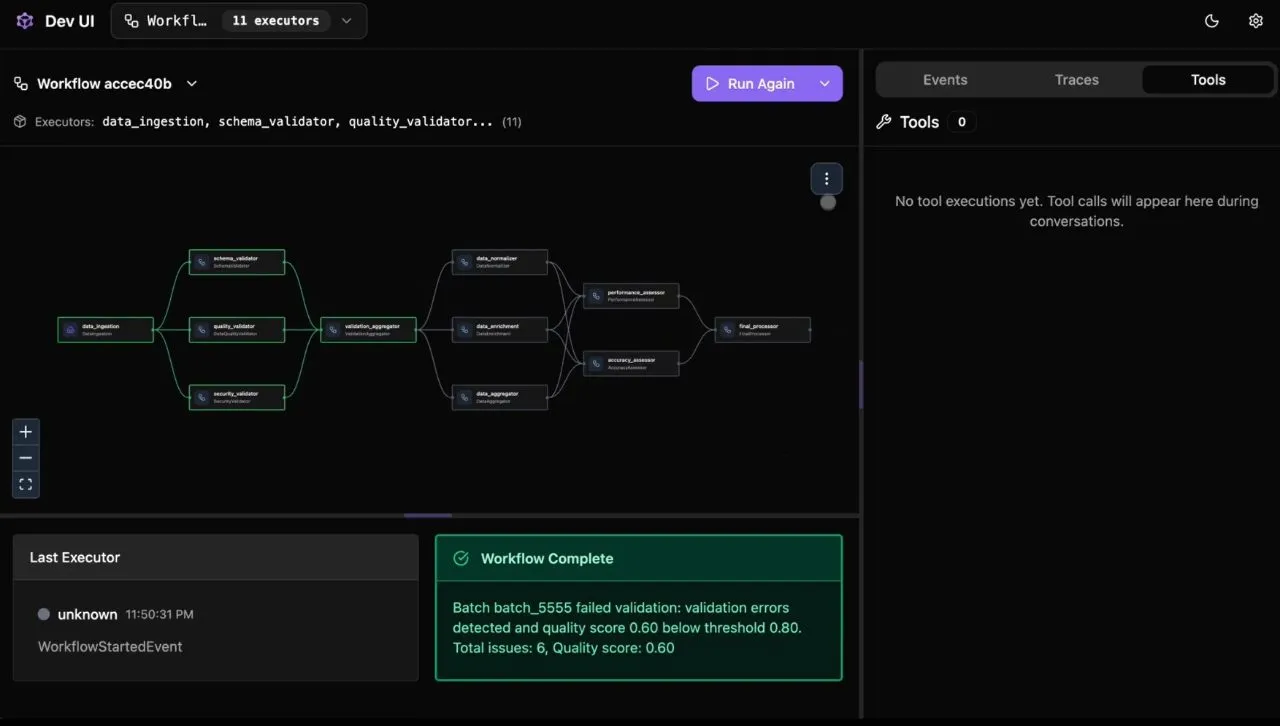 (opens full size in a new tab)
Facts
- Price
- Free plan
- Runs on
- .NETPythonGo (public preview)
- License
- MIT, open source
- Category
- AI
- Facts checked
Price checked · Current prices on learn.microsoft.com ↗
Our verdict
#4 of 10 in AI agent frameworks
For .NET shops and AutoGen users
What it does
- Stable .NET and Python SDKs with one design
- Graph workflows with checkpoints and human approvals
- Sequential, concurrent, handoff, group chat, and Magentic-One patterns
- Connectors for Azure, OpenAI, Anthropic, Bedrock, Gemini, and Ollama
- OpenTelemetry tracing and a local DevUI debugger
Pros
- First-class .NET support
- Migration guides from AutoGen and Semantic Kernel
- Wide set of multi-agent patterns, plus A2A
- Exports no telemetry until you configure it
Cons
- Short track record, with some debugging and hosting pieces in preview
- Many examples assume Azure or Foundry
- No TypeScript version
- Choose if:
- Your codebase is C#, or you have AutoGen or Semantic Kernel code to move
About Microsoft Agent Framework
Microsoft Agent Framework is an open-source SDK and runtime for building single agents and multi-agent workflows in .NET and Python, both at stable 1.0 since April 2026; a Go version is in public preview. It is the direct successor to Semantic Kernel and AutoGen, combining AutoGen’s agent abstractions with Semantic Kernel’s enterprise features and adding graph-based workflows with checkpointing and human-in-the-loop approvals. It ships orchestration patterns (sequential, concurrent, handoff, group chat, Magentic-One), MCP and A2A support, OpenTelemetry tracing and connectors for Foundry, Azure OpenAI, OpenAI, Anthropic, Bedrock, Gemini and Ollama. It is MIT licensed; Microsoft Foundry hosting is optional.
Ranked in
-
#4 of 10 AI agent frameworks For .NET shops and AutoGen users 3.9/5
How it scored
-
Control over flow and state , counts double 4/5
The free library has a stable graph workflow engine with checkpointing, pause/resume and human-in-the-loop approvals. It is unclear whether it can rewind or edit saved state, so it stops short of 5.
4/5 means: A workflow or graph engine in the free library with saved state, pause and resume, and human approvals
Agent Workflows – The graph-based workflow engine for composing agents and functions into deterministic, repeatable processes is now stable. Build workflows that combine agent reasoning with business logic, branch on conditions, fan out to parallel steps, and converge results. Checkpointing and hydration ensure long-running processes survive interruptions.
devblogs.microsoft.com/agent-framework/microsoft-agent-framework-version-1-0 · published · checked Stable support for the orchestration patterns that emerged from Microsoft Research and AutoGen: sequential, concurrent, handoff, group chat, and Magentic-One. All patterns support streaming, checkpointing, human-in-the-loop approvals, and pause/resume for long-running workflows.
devblogs.microsoft.com/agent-framework/microsoft-agent-framework-version-1-0 · published · checked
-
Production track record and API stability 4/5
Stable 1.0 for .NET and Python with a stated long-term support and backward-compatibility commitment, from Microsoft, for whom it is the main agent SDK. It is about 7 months past 1.0, and the AutoGen it succeeds is now archived.
4/5 means: Stable 1.0 or later with a stability commitment, active maintenance and named production users
Today, we’re thrilled to announce that Microsoft Agent Framework has reached version 1.0 for both .NET and Python. This is the production-ready release: stable APIs, and a commitment to long-term support.
devblogs.microsoft.com/agent-framework/microsoft-agent-framework-version-1-0 · published · checked This project has been archived and is no longer actively maintained by Microsoft. Microsoft is not providing bug fixes, security fixes, new features, or support for this project.
github.com/microsoft/autogen · checked New users should start with Microsoft Agent Framework. Existing users are encouraged to migrate using the AutoGen → Microsoft Agent Framework migration guide.
github.com/microsoft/autogen · checked
-
Tracing and debugging 4/5
Built-in OpenTelemetry traces, logs and metrics following the GenAI conventions, exportable to any backend, plus the free local DevUI debugger (preview at 1.0) and the Aspire Dashboard. No rewind or replay was found.
4/5 means: Built-in tracing to the backend you choose, plus a visual debugger or trace viewer, local or from the maker, usable without a paid plan
DevUI – browser-based local debugger for visualizing agent execution, message flows, tool calls, and orchestration decisions in real time.
devblogs.microsoft.com/agent-framework/microsoft-agent-framework-version-1-0 · published · checked Agent Framework integrates with OpenTelemetry, and more specifically Agent Framework emits traces, logs, and metrics according to the OpenTelemetry GenAI Semantic Conventions.
learn.microsoft.com/en-us/agent-framework/agents/observability · checked We do not install exporters by default to prevent unnecessary dependencies and potential issues with auto instrumentation.
learn.microsoft.com/en-us/agent-framework/agents/observability · checked For local development, consider using the Aspire Dashboard.
learn.microsoft.com/en-us/agent-framework/agents/observability · checked
Show all 4
-
Freedom to switch model providers 4/5
First-party connectors for Foundry, Azure OpenAI, OpenAI, Anthropic, Bedrock, Gemini and Ollama, with ONNX samples. Docs examples lean on Foundry and Azure identity.
4/5 means: Native support for the major providers and local models, switched through configuration
Agent Framework ships with first-party service connectors for Microsoft Foundry, Azure OpenAI, OpenAI, Anthropic Claude, Amazon Bedrock, Google Gemini and Ollama.
devblogs.microsoft.com/agent-framework/microsoft-agent-framework-version-1-0 · published · checked Agent Framework is a MIT license project were you have the flexibility to customize it for your own cases.
Roger Barreto, Microsoft employee · devblogs.microsoft.com/agent-framework/microsoft-agent-framework-version-1-0 · published · checked
-
Multi-agent support 5/5
Sequential, concurrent, handoff, group chat and Magentic-One patterns, built in and controllable in code, plus A2A and MCP support. A2A 1.0 support was listed as coming soon in April 2026.
5/5 means: Everything in 4, plus A2A support so agents can work with agents in other frameworks or services
Stable support for the orchestration patterns that emerged from Microsoft Research and AutoGen: sequential, concurrent, handoff, group chat, and Magentic-One. All patterns support streaming, checkpointing, human-in-the-loop approvals, and pause/resume for long-running workflows.
devblogs.microsoft.com/agent-framework/microsoft-agent-framework-version-1-0 · published · checked MCP (Model Context Protocol) support lets agents dynamically discover and invoke external tools exposed over MCP-compliant servers. A2A (Agent-to-Agent) protocol (A2A 1.0 support coming soon) support enables cross-runtime agent collaboration
devblogs.microsoft.com/agent-framework/microsoft-agent-framework-version-1-0 · published · checked
-
Learning curve and everyday developer experience 3/5
Short quickstarts in .NET and Python and extensive Microsoft Learn docs, but the framework is young, its examples lean on Azure and Foundry setup, and some debugging tools were still preview at 1.0.
3/5 means: Takes days to learn, or is quick to start but harder to change and debug as the agent grows; practitioners' reports are mixed
-
Integrations and community help , counts half 3/5
MCP support and pluggable memory backends (Mem0, Redis, Neo4j) plus many connectors, but the community is smaller than the older frameworks.
3/5 means: MCP support and the common integrations, with a moderate community
Agent Framework ships with first-party service connectors for Microsoft Foundry, Azure OpenAI, OpenAI, Anthropic Claude, Amazon Bedrock, Google Gemini and Ollama.
devblogs.microsoft.com/agent-framework/microsoft-agent-framework-version-1-0 · published · checked Agent Memory and Context Providers – Pluggable memory architecture supporting conversational history, persistent key-value state, and vector-based retrieval. Choose your backend: Memory in Foundry Agent Service, Mem0, Redis, Neo4j or use a custom store.
devblogs.microsoft.com/agent-framework/microsoft-agent-framework-version-1-0 · published · checked MCP (Model Context Protocol) support lets agents dynamically discover and invoke external tools exposed over MCP-compliant servers. A2A (Agent-to-Agent) protocol (A2A 1.0 support coming soon) support enables cross-runtime agent collaboration
devblogs.microsoft.com/agent-framework/microsoft-agent-framework-version-1-0 · published · checked
Top of this ranking
- LangGraph #1
- Pydantic AI #2
- Mastra #3
-


Sources
19 quotes from 5 pages; the 12 most useful are below.
-
Limits and known issues 3
As for status, Microsoft now positions Agent Framework as the successor for new agent-development work; AutoGen is still being maintained with bug fixes and critical security patches, while Semantic Kernel remains active, with recent releases still appearing in its GitHub repo.
David Ramel, writer at Visual Studio Magazine · visualstudiomagazine.com/articles/2026/04/06/microsoft-ships-production-ready-agent-framework-1-0-for-net-and-python.aspx · published · checked This project has been archived and is no longer actively maintained by Microsoft. Microsoft is not providing bug fixes, security fixes, new features, or support for this project.
github.com/microsoft/autogen · checked New users should start with Microsoft Agent Framework. Existing users are encouraged to migrate using the AutoGen → Microsoft Agent Framework migration guide.
github.com/microsoft/autogen · checked
-
Features 7
Agent Framework combines AutoGen's simple agent abstractions with Semantic Kernel's enterprise features — session-based state management, type safety, middleware, telemetry — and adds graph-based workflows for explicit multi-agent orchestration.
learn.microsoft.com/en-us/agent-framework/overview · checked The Agent Framework is the direct successor, created by the same teams. It combines AutoGen's simple abstractions for single- and multi-agent patterns with Semantic Kernel's enterprise-grade features such as session-based state management, type safety, filters, telemetry, and extensive model and embedding support.
learn.microsoft.com/en-us/agent-framework/overview · checked Agent Framework integrates with OpenTelemetry, and more specifically Agent Framework emits traces, logs, and metrics according to the OpenTelemetry GenAI Semantic Conventions.
learn.microsoft.com/en-us/agent-framework/agents/observability · checked We do not install exporters by default to prevent unnecessary dependencies and potential issues with auto instrumentation.
learn.microsoft.com/en-us/agent-framework/agents/observability · checked For local development, consider using the Aspire Dashboard.
learn.microsoft.com/en-us/agent-framework/agents/observability · checked Today, we’re thrilled to announce that Microsoft Agent Framework has reached version 1.0 for both .NET and Python. This is the production-ready release: stable APIs, and a commitment to long-term support.
devblogs.microsoft.com/agent-framework/microsoft-agent-framework-version-1-0 · published · checked Agent Workflows – The graph-based workflow engine for composing agents and functions into deterministic, repeatable processes is now stable. Build workflows that combine agent reasoning with business logic, branch on conditions, fan out to parallel steps, and converge results. Checkpointing and hydration ensure long-running processes survive interruptions.
devblogs.microsoft.com/agent-framework/microsoft-agent-framework-version-1-0 · published · checked
Show all 7
-
Platforms and requirements 1
Agent Framework for Go is in public preview and requires Go 1.26 or later. Declarative agents, CodeAct, and functional workflows aren't implemented in Go.
learn.microsoft.com/en-us/agent-framework/overview · checked
-
License 1
Agent Framework is a MIT license project were you have the flexibility to customize it for your own cases.
Roger Barreto, Microsoft employee · devblogs.microsoft.com/agent-framework/microsoft-agent-framework-version-1-0 · published · checked