
OpenAI Agents SDK
OpenAI's lightweight open-source SDK for building multi-agent workflows in Python and TypeScript, with handoffs, guardrails, sessions and built-in tracing.
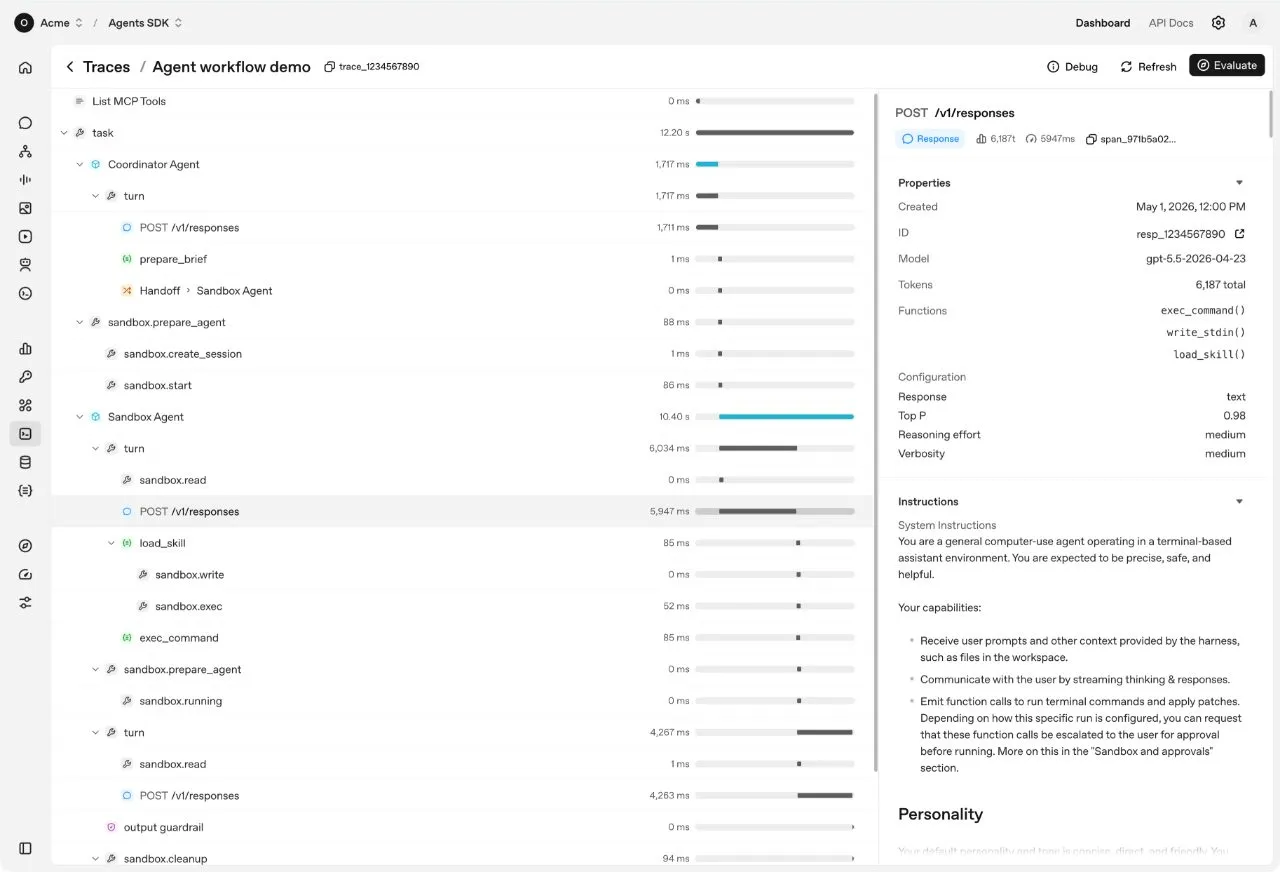 (opens full size in a new tab)
Facts
- Price
- Free plan
- Runs on
- Python 3.10 or laterNode.js 22 or later (TypeScript SDK)Deno (TypeScript SDK)Bun (TypeScript SDK)
- Category
- AI
- Facts checked
Price checked · Current prices on openai.github.io ↗
Our verdict
#9 of 10 in AI agent frameworks
Simplest start on OpenAI models
What it does
- Agents, tools, handoffs, and agents called as tools
- Guardrails and human approval steps
- Sessions that save conversation history
- Built-in tracing with a free dashboard on OpenAI's platform
- Python and TypeScript SDKs
Pros
- Smallest API to learn
- Free hosted trace viewer with no setup
- Full support for OpenAI's Responses API features
Cons
- Non-OpenAI models lose features
- Sends traces with model inputs and outputs to OpenAI by default
- No checkpoints inside a run without an outside engine
- Upgrades between minor releases can break code
- Choose if:
- You're committed to OpenAI's models and your agents are short tool-calling loops
About OpenAI Agents SDK
The OpenAI Agents SDK is an open-source library (MIT-licensed) for building LLM agents in code, with separate Python (openai-agents) and TypeScript (@openai/agents) packages. An Agent plus a Runner owns the tool-calling loop, and multi-agent work uses handoffs or agents-as-tools. It also covers guardrails, sessions for conversation history, human-in-the-loop approvals, MCP tools, sandbox agents, and realtime and voice agents. It defaults to OpenAI models and tracing to OpenAI’s Traces dashboard, and reaches other providers through OpenAI-compatible endpoints or the LiteLLM and any-LLM adapters, with some features available only on OpenAI’s Responses API. The SDK is free; you pay only for model usage. It is aimed at developers who want a small set of primitives instead of a graph framework.
What users say
Only one practitioner account was read, so none of this reflects a widely shared view. The author calls the SDK the fastest path to a working multi-agent prototype on OpenAI models, and praises handoffs as simple to extend. The same author warns that it is pre-1.0 with signatures that have broken between minor releases, that sessions do not checkpoint mid-run tool calls, that routing through handoffs lives in prompts, and that traces live in OpenAI's platform rather than your own observability stack.
4 quotes from users and reviewers
What a session does not give you is checkpointing of mid-run tool calls. If your agent dies halfway through a five-tool sequence, the session resumes from the last persisted turn, not the last persisted tool. If exactly-where-it-crashed resumption is load-bearing for you, that is a checkpointer's job, and the Agents SDK does not have one.
Gabriel Anhaia, developer and author of books on agents and LLM observability · dev.to/gabrielanhaia/the-openai-agents-sdk-in-production-what-it-gives-you-and-what-it-hides-16a9 · published · checked The catch to know before you commit: non-OpenAI calls do not show up in the built-in platform tracer. The moment you go multi-provider, half your run stops appearing in the one observability surface the SDK gave you for free.
Gabriel Anhaia, developer and author of books on agents and LLM observability · dev.to/gabrielanhaia/the-openai-agents-sdk-in-production-what-it-gives-you-and-what-it-hides-16a9 · published · checked The SDK is young and cuts roughly one minor a month. Signatures have broken between minors, so treat every upgrade as potentially breaking. Pin it, and upgrade on a branch with your evals wired up.
Gabriel Anhaia, developer and author of books on agents and LLM observability · dev.to/gabrielanhaia/the-openai-agents-sdk-in-production-what-it-gives-you-and-what-it-hides-16a9 · published · checked The SDK is the fastest path to a working multi-agent prototype on OpenAI models. What it hides is the seam between "works in the demo" and "runs in your stack."
Gabriel Anhaia, developer and author of books on agents and LLM observability · dev.to/gabrielanhaia/the-openai-agents-sdk-in-production-what-it-gives-you-and-what-it-hides-16a9 · published · checked
Ranked in
-
#9 of 10 AI agent frameworks Simplest start on OpenAI models 3.2/5
How it scored
-
Control over flow and state , counts double 3/5
An agent loop with sessions and built-in human-in-the-loop approvals, but multi-step flows are your own code and a practitioner says there is no mid-run checkpointing, so crash recovery needs an outside engine such as Temporal (not verified here).
3/5 means: An agent loop that can pause for human approval and save sessions, but multi-step flows are your own code and crash recovery needs an outside engine
What a session does not give you is checkpointing of mid-run tool calls. If your agent dies halfway through a five-tool sequence, the session resumes from the last persisted turn, not the last persisted tool. If exactly-where-it-crashed resumption is load-bearing for you, that is a checkpointer's job, and the Agents SDK does not have one.
Gabriel Anhaia, developer and author of books on agents and LLM observability · dev.to/gabrielanhaia/the-openai-agents-sdk-in-production-what-it-gives-you-and-what-it-hides-16a9 · published · checked Agents as tools / Handoffs: Delegating to other agents for specific tasks
github.com/openai/openai-agents-python · checked
-
Production track record and API stability 3/5
Pre-1.0 with monthly minors whose signatures have broken between releases, but actively maintained by OpenAI and in wide production use (about 30.8k GitHub stars on the Python repo). Wide use despite pre-1.0 is the level-3 description.
3/5 means: Usable in production, but upgrades break things often, through pre-1.0 releases, a recent major rewrite, or a maker whose focus has moved elsewhere
The SDK is young and cuts roughly one minor a month. Signatures have broken between minors, so treat every upgrade as potentially breaking. Pin it, and upgrade on a branch with your evals wired up.
Gabriel Anhaia, developer and author of books on agents and LLM observability · dev.to/gabrielanhaia/the-openai-agents-sdk-in-production-what-it-gives-you-and-what-it-hides-16a9 · published · checked Star30.8k (30.8k)
github.com/openai/openai-agents-python · checked
-
Tracing and debugging 4/5
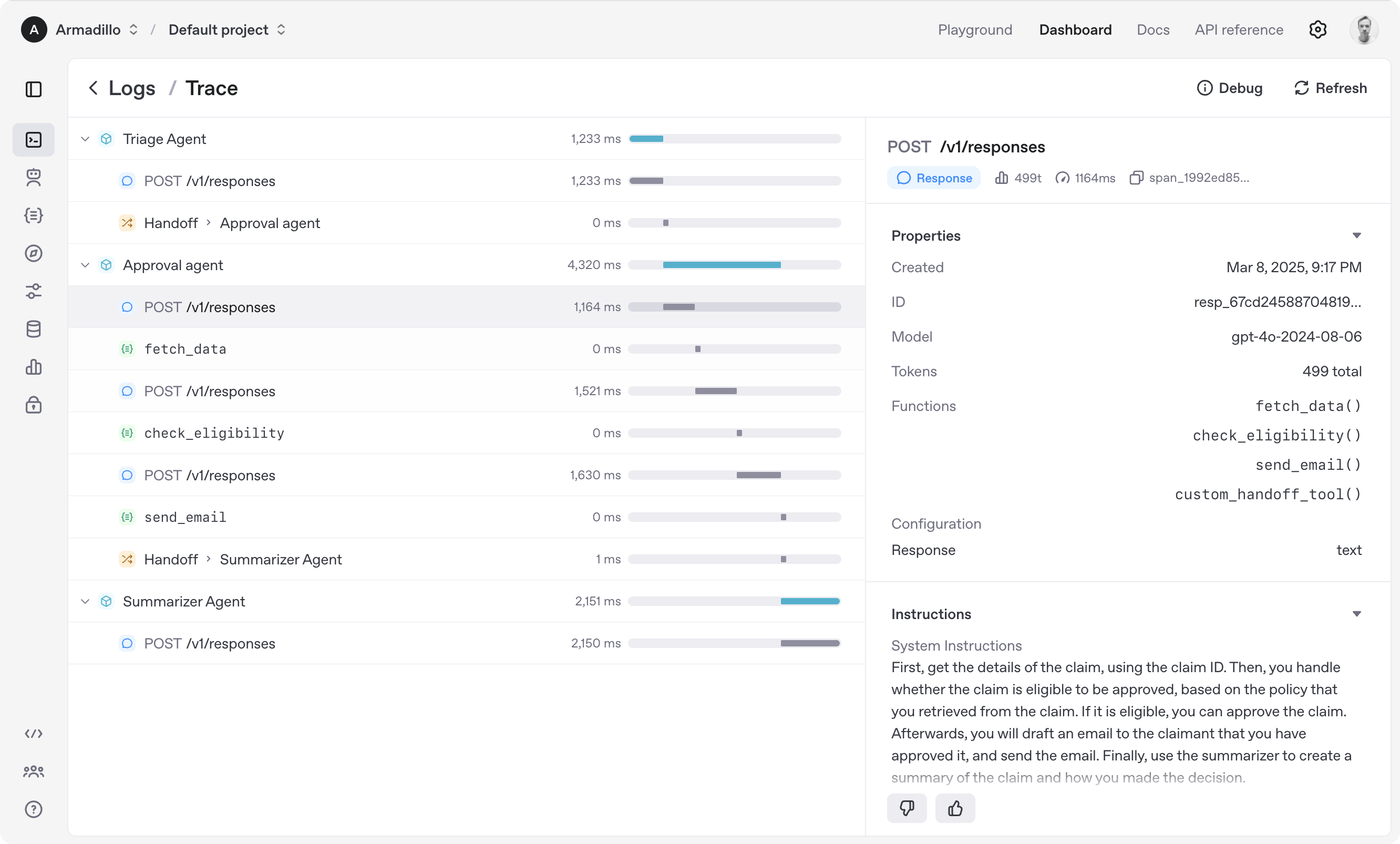
Built-in traces of model, tool, handoff and guardrail spans, with custom processors to send them to another backend and a free trace viewer from OpenAI. The viewer needs an OpenAI account, is unavailable under zero data retention, and a practitioner says traces are not correlated with your own observability without extra work.
4/5 means: Built-in tracing to the backend you choose, plus a visual debugger or trace viewer, local or from the maker, usable without a paid plan
Tracing is enabled by default. You can disable it in three common ways:
openai.github.io/openai-agents-python/tracing · checked Tracing is unavailable for organizations that use OpenAI's APIs under a Zero Data Retention (ZDR) policy.
openai.github.io/openai-agents-python/tracing · checked set_trace_processors() lets you replace the default processors with your own trace processors. This means traces will not be sent to the OpenAI backend unless you include a TracingProcessor that does so.
openai.github.io/openai-agents-python/tracing · checked When using non-OpenAI models, you can provide an OpenAI API key to the tracing exporter to enable free tracing in the OpenAI Traces dashboard without disabling tracing.
openai.github.io/openai-agents-python/tracing · checked The catch to know before you commit: non-OpenAI calls do not show up in the built-in platform tracer. The moment you go multi-provider, half your run stops appearing in the one observability surface the SDK gave you for free.
Gabriel Anhaia, developer and author of books on agents and LLM observability · dev.to/gabrielanhaia/the-openai-agents-sdk-in-production-what-it-gives-you-and-what-it-hides-16a9 · published · checked
Show all 5
-
Freedom to switch model providers 2/5
Built around OpenAI's Responses API. Other providers work through Chat Completions, LiteLLM or any-LLM adapters, which lose Responses-only settings and tools, and the docs advise one model shape per workflow. Adapters that lose features are the level-2 description.
2/5 means: Built around one maker's models; others work only through adapters that lose features
The OpenAI Agents SDK is a lightweight yet powerful framework for building multi-agent workflows. It is provider-agnostic, supporting the OpenAI Responses and Chat Completions APIs, as well as 100+ other LLMs.
github.com/openai/openai-agents-python · checked In these examples, we use the Chat Completions API/model, because many LLM providers still do not support the Responses API. If your LLM provider does support it, we recommend using Responses.
openai.github.io/openai-agents-python/models · checked reasoning.mode and reasoning.context are Responses-only settings. Chat Completions uses only reasoning.effort, and the supported effort levels depend on the model and API surface.
openai.github.io/openai-agents-python/models · checked While our SDK supports both the OpenAIResponsesModel and the OpenAIChatCompletionsModel shapes, we recommend using a single model shape for each workflow because the two shapes support a different set of features and tools.
openai.github.io/openai-agents-python/models · checked
Show all 4
-
Multi-agent support 3/5
Two built-in patterns, handoffs and agents-as-tools, with routing decided by the model through prompts. No supervisor, group-chat or A2A support was found.
3/5 means: Built-in delegation such as handoffs or subagents, in one or two patterns
A handoff is a delegation from one agent to another, modelled to the LLM as a regular tool call. When the model decides to hand off, the SDK swaps the active agent mid-run (new instructions, new tools, same conversation) and keeps going.
Gabriel Anhaia, developer and author of books on agents and LLM observability · dev.to/gabrielanhaia/the-openai-agents-sdk-in-production-what-it-gives-you-and-what-it-hides-16a9 · published · checked Input guardrails fire only for the first agent in a chain; after a handoff they do not re-run. Output guardrails fire only for the agent that produces the final output. Tool guardrails run on every function-tool call but not on handoffs, because handoffs are a separate pipeline.
Gabriel Anhaia, developer and author of books on agents and LLM observability · dev.to/gabrielanhaia/the-openai-agents-sdk-in-production-what-it-gives-you-and-what-it-hides-16a9 · published · checked Agents as tools / Handoffs: Delegating to other agents for specific tasks
github.com/openai/openai-agents-python · checked
-
Learning curve and everyday developer experience 4/5
Small Agent plus Runner model that gets a working agent in a few lines, with clear docs. The practitioner source warns about hidden behavior, prompt-held control flow and upgrade breakage; only one practitioner was read.
4/5 means: Quick to a working agent with clear docs, and few surprises as the agent grows
The SDK is the fastest path to a working multi-agent prototype on OpenAI models. What it hides is the seam between "works in the demo" and "runs in your stack."
Gabriel Anhaia, developer and author of books on agents and LLM observability · dev.to/gabrielanhaia/the-openai-agents-sdk-in-production-what-it-gives-you-and-what-it-hides-16a9 · published · checked A handoff is a delegation from one agent to another, modelled to the LLM as a regular tool call. When the model decides to hand off, the SDK swaps the active agent mid-run (new instructions, new tools, same conversation) and keeps going.
Gabriel Anhaia, developer and author of books on agents and LLM observability · dev.to/gabrielanhaia/the-openai-agents-sdk-in-production-what-it-gives-you-and-what-it-hides-16a9 · published · checked What a session does not give you is checkpointing of mid-run tool calls. If your agent dies halfway through a five-tool sequence, the session resumes from the last persisted turn, not the last persisted tool. If exactly-where-it-crashed resumption is load-bearing for you, that is a checkpointer's job, and the Agents SDK does not have one.
Gabriel Anhaia, developer and author of books on agents and LLM observability · dev.to/gabrielanhaia/the-openai-agents-sdk-in-production-what-it-gives-you-and-what-it-hides-16a9 · published · checked
-
Integrations and community help , counts half 4/5
MCP and hosted tools, many tracing-processor integrations, and about 30.8k GitHub stars for the Python repo, a large community; the TypeScript repo is much smaller.
4/5 means: MCP support, many ready-made integrations, and a large community with plenty of examples and answers
Agents as tools / Handoffs: Delegating to other agents for specific tasks
github.com/openai/openai-agents-python · checked Star30.8k (30.8k)
github.com/openai/openai-agents-python · checked Star4k (4k)
github.com/openai/openai-agents-js · checked
Top of this ranking
- LangGraph #1
- Pydantic AI #2
- Mastra #3
-


Sources
23 quotes from 5 pages; the 13 most useful are below.
-
Limits and known issues 5
What a session does not give you is checkpointing of mid-run tool calls. If your agent dies halfway through a five-tool sequence, the session resumes from the last persisted turn, not the last persisted tool. If exactly-where-it-crashed resumption is load-bearing for you, that is a checkpointer's job, and the Agents SDK does not have one.
Gabriel Anhaia, developer and author of books on agents and LLM observability · dev.to/gabrielanhaia/the-openai-agents-sdk-in-production-what-it-gives-you-and-what-it-hides-16a9 · published · checked reasoning.mode and reasoning.context are Responses-only settings. Chat Completions uses only reasoning.effort, and the supported effort levels depend on the model and API surface.
openai.github.io/openai-agents-python/models · checked While our SDK supports both the OpenAIResponsesModel and the OpenAIChatCompletionsModel shapes, we recommend using a single model shape for each workflow because the two shapes support a different set of features and tools.
openai.github.io/openai-agents-python/models · checked Tracing is unavailable for organizations that use OpenAI's APIs under a Zero Data Retention (ZDR) policy.
openai.github.io/openai-agents-python/tracing · checked By default, trace_include_sensitive_data is True.
openai.github.io/openai-agents-python/tracing · checked
-
What users say 1
The catch to know before you commit: non-OpenAI calls do not show up in the built-in platform tracer. The moment you go multi-provider, half your run stops appearing in the one observability surface the SDK gave you for free.
Gabriel Anhaia, developer and author of books on agents and LLM observability · dev.to/gabrielanhaia/the-openai-agents-sdk-in-production-what-it-gives-you-and-what-it-hides-16a9 · published · checked
-
Features 6
A handoff is a delegation from one agent to another, modelled to the LLM as a regular tool call. When the model decides to hand off, the SDK swaps the active agent mid-run (new instructions, new tools, same conversation) and keeps going.
Gabriel Anhaia, developer and author of books on agents and LLM observability · dev.to/gabrielanhaia/the-openai-agents-sdk-in-production-what-it-gives-you-and-what-it-hides-16a9 · published · checked The OpenAI Agents SDK is a lightweight yet powerful framework for building multi-agent workflows. It is provider-agnostic, supporting the OpenAI Responses and Chat Completions APIs, as well as 100+ other LLMs.
github.com/openai/openai-agents-python · checked In these examples, we use the Chat Completions API/model, because many LLM providers still do not support the Responses API. If your LLM provider does support it, we recommend using Responses.
openai.github.io/openai-agents-python/models · checked Tracing is enabled by default. You can disable it in three common ways:
openai.github.io/openai-agents-python/tracing · checked Agents as tools / Handoffs: Delegating to other agents for specific tasks
github.com/openai/openai-agents-python · checked The OpenAI Agents SDK is a lightweight yet powerful framework for building multi-agent workflows in JavaScript/TypeScript. It is provider-agnostic, supporting OpenAI APIs and more.
github.com/openai/openai-agents-js · checked
Show all 6
-
Platforms and requirements 1
To get started, set up your Python environment (Python 3.10 or newer required), and then install OpenAI Agents SDK package.
github.com/openai/openai-agents-python · checked