Hosted website analytics counts your visitors and turns their activity into reports on the vendor’s servers. You add a small tracking script to your site; the vendor operates the analytics application, database, backups and updates. These tools focus on website traffic and marketing—what people read, where they came from and whether they signed up or bought something—not on managing features inside a software product.
Plausible Analytics is the best starting point for most businesses and publishers. Its dashboard makes the important numbers easy to explain to a colleague or client, and its visitor data stays on European-owned infrastructure in the EU. Choose its Business plan rather than the entry plan if you need funnels, revenue attribution, which connects revenue to the marketing source that produced it, or programmatic access to your reports.
Pirsch Analytics is the better value for many small client sites, and Fathom Analytics is an equally clear alternative with strong email reports. Umami has the most useful free plan for a site that needs conversion analysis, while GoatCounter covers basic traffic statistics for nothing. Matomo Cloud is the choice for a marketing team that will use its much broader reports, not for someone trying to escape Google Analytics’ complexity.
Prices start at the following points, as of November 2026. A custom event records an action such as a signup or purchase. A funnel shows how many visitors complete each step in a sequence, such as opening a product page, starting checkout and paying. Plan allowances are not interchangeable: Plausible, Fathom and Pirsch count events alongside page views; Umami also charges for each saved event property; Matomo counts a wider range of tracked interactions as “hits.”
| Service | Starting price | What the entry plan covers |
|---|---|---|
| Plausible | $9/month | One website; Starter omits funnels and revenue reporting by marketing source |
| Pirsch | $6/month | 10,000 monthly page views, 50 websites and unlimited members |
| Fathom | $15/month | 100,000 monthly page views and events, with 50 websites |
| Umami | $20/month | One million events, 20 websites and ten team members; free Hobby plan also available |
| Matomo Cloud | $26/month before tax | 30 websites and 30 team members, with broad marketing reports |
| GoatCounter | Free | Reasonable public usage, including small-to-medium businesses |
Key facts
6 productsLicenses, requirements and starting prices. Prices as of November 2026.
- License
- AGPL-3.0 (Community Edition), open source
- Runs on
- Vendor-hosted web application and tracking script
- Self-hosted Community Edition: any server that runs Docker, with an x86-64 processor that has SSE 4.2 or an ARM processor with NEON
- Needs
- Managed service: add the tracking script or a supported website integration
- Self-hosted Community Edition: Docker, PostgreSQL and ClickHouse; 2 GB of RAM recommended
- Price
- From $9.00/month
- License
- Proprietary managed service with an open-source core
- Runs on
- Vendor-hosted web application on servers in Germany
- Needs
- Tracking script, server-side integration or a supported website integration
- Price
- From $6.00/month
- License
- MIT, open source
- Runs on
- Vendor-hosted web application and tracking script
- Self-hosted edition: any server with Node.js 20.19 or newer, or Docker
- Needs
- Managed service: add the tracking script or a supported website integration
- Self-hosted edition: PostgreSQL 12.14 or newer
- Price
- Free plan
- License
- Proprietary
- Runs on
- Vendor-hosted web application and tracking script
- Needs
- JavaScript tracking or one of the supported website integrations
- A paid subscription after a 7-day trial; a card is required for the trial
- Price
- From $15.00/month
- License
- EUPL 1.2 (slightly modified), open source
- Runs on
- Vendor-hosted web application and tracking script
- Self-hosted edition: prebuilt binaries for several platforms or Docker
- Needs
- Hosted service: add the tracking script, image tracker or backend integration
- Self-hosted edition: nothing beyond the program when data is kept in SQLite; PostgreSQL is optional
- Price
- Free plan
- License
- GPL, open source
- Runs on
- Vendor-hosted web application and tracking script
- On-Premise: Linux, Windows, macOS Server, FreeBSD or Docker
- Needs
- Cloud: add the tracking script or a supported website integration
- On-Premise: PHP 8, MySQL or MariaDB, and a web server such as Apache, Nginx or IIS
- Price
- From $26.00/month






Plausible Analytics suits a business owner or publisher who wants to understand a website in a few minutes rather than learn a reporting system. Traffic sources, popular pages, campaigns and conversions share a compact dashboard. Clicking through a source or page filters the results, so a reader can follow a question without constructing a custom report.
Its European operation is unusually straightforward. Plausible processes visitor data on infrastructure owned by European companies and keeps that data in the EU. Tracking uses no cookies or persistent visitor identifiers. Pirsch offers a similarly clear EU-storage arrangement; Fathom stores anonymized analytics in the US, while Umami uses servers in the US and EU.
The entry price needs a plan-name caveat. Starter begins at $9 a month for one site, but funnels, user journeys and revenue attribution belong to Business, which starts at $19 a month (as of November 2026). That plan also lets you filter by custom details attached to events, such as a product category, and query report data from your own software through the Stats API. Business also allows ten sites and ten team members. If you run many low-traffic client sites, Pirsch or Fathom gives you a larger site allowance for less.
Moving from Google Analytics 4 is easier than moving raw data out later. Plausible imports GA4 history, and every plan can export dashboard reports as CSV files. The Stats API requires Business. You can download aggregated CSV reports on every plan, while scheduled exports of individual events require a custom Enterprise plan. A one-off busy month is less worrying: Plausible does not stop collection or add a surprise charge, and it asks for an upgrade only when high usage continues.
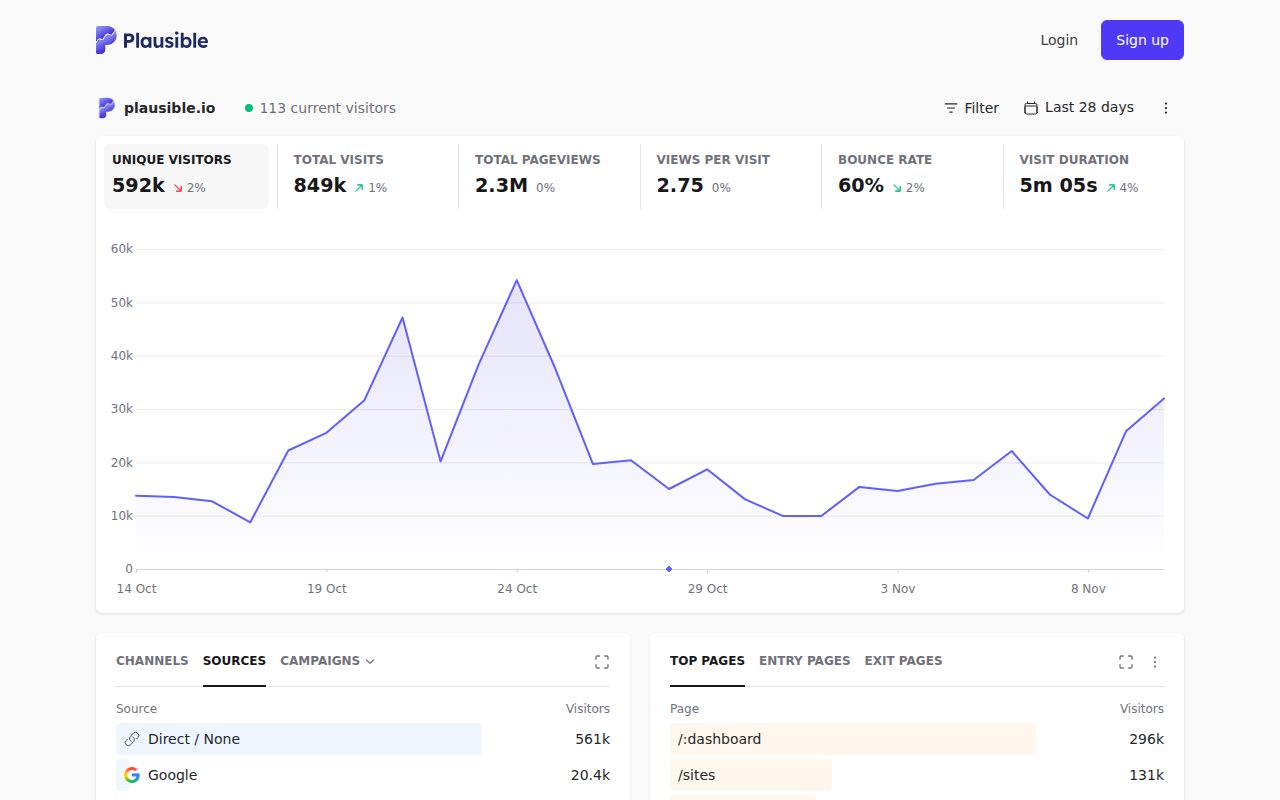
What it does
- One-page traffic, source, campaign and conversion dashboard
- GA4 history import and Search Console integration
- Funnels, user journeys and revenue reporting by marketing source on Business
- Password-protected shared dashboards and scheduled email reports
- Visitor data processed and stored on European-owned infrastructure
Pros
- Routine website and campaign results are easy for non-specialists to read
- No cookies or persistent visitor identifiers; analytics data stays in the EU
- Occasional traffic spikes do not interrupt collection or trigger surprise fees
- GA4 history can be imported directly
Cons
- Funnels, revenue attribution, event-property filtering and the reporting API require Business
- Starter includes only one website; Business allows ten
- Scheduled event-level exports require an Enterprise plan; aggregated CSV reports are available on every plan
Skip if: Agencies that need dozens of client sites on an inexpensive standard plan.
Fathom Analytics is the closest alternative to Plausible for a reader who wants a polished, uncomplicated dashboard. It shows popular pages, traffic sources, campaign results and events on one page. Filters answer follow-up questions, and saved views preserve a report you check every week. Fathom is cloud-only, so there is no current self-hosted edition to maintain.
Every plan includes the same analytics features and at least 50 websites. The $15-a-month starting plan covers 100,000 page views and custom events combined (as of November 2026). An all-sites view gives an agency a portfolio summary, while scheduled emails can combine only the sites selected for each client. That makes Fathom easier to hand to clients than Umami and less restrictive about site count than Plausible.
Its conversion reports stop at events and their monetary values. You can measure purchases and campaign conversions, but you cannot build the multi-step funnels available in Umami, Plausible Business or Pirsch Plus. If the central question is where visitors abandon a checkout or signup sequence, Fathom is the wrong choice despite its excellent everyday reports.
Fathom’s privacy arrangement deserves a precise reading. It uses no cookies and processes EU visitors’ personal data in the EU, but stores the resulting anonymized analytics on US infrastructure. That may be perfectly acceptable; it is not the same as Plausible or Pirsch keeping the stored data in the EU. Fathom can import GA4 history, although the importer leaves out GA events and does not recreate every report, and imported data supports fewer filters.
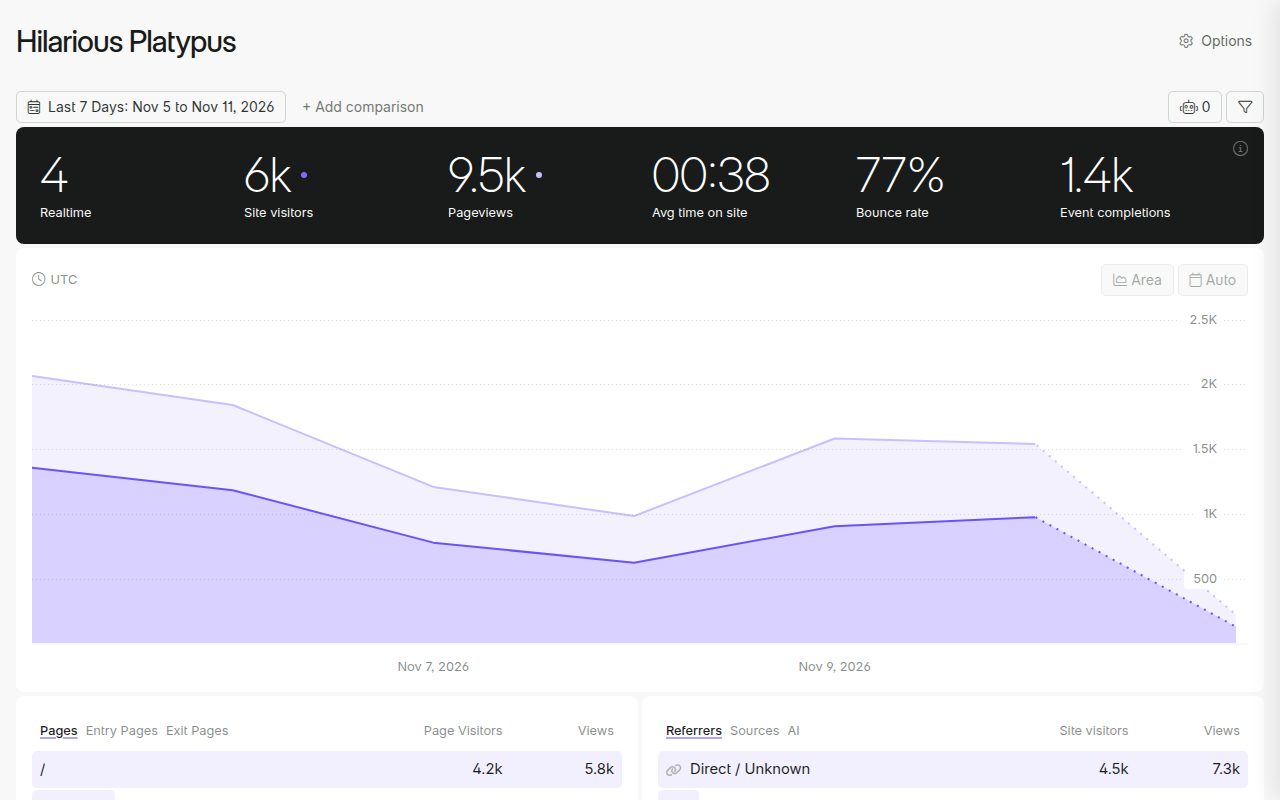
What it does
- Single-page dashboard with filters and saved views
- Fifty sites, an all-sites view and combined client email reports
- Campaign tracking and events with monetary values
- GA4 history import and Search Console integration
- CSV exports, API and ongoing history while subscribed
Pros
- Clear reports that need little client training
- Generous site allowance with every feature on every plan
- Scheduled emails can combine selected sites for each recipient
- Occasional traffic spikes do not stop data collection
Cons
- No multi-step funnel reports
- Anonymized analytics are stored on US infrastructure
- No permanent free plan; the seven-day trial requires a card
- GA4 imports omit events and have more limited filtering
Skip if: Marketing teams that need funnel analysis or EU-only storage of their analytics.
Pirsch Analytics is the strongest choice for an agency, consultant or business with a collection of small websites. Standard starts at $6 a month for 10,000 monthly page views and includes 50 websites and unlimited members (as of November 2026). Its one-page dashboard lets a reader click a page, source or other dimension to filter the whole report, then save that view for later.
Standard already includes custom events, conversion goals, session summaries, automatic email reports and private dashboard links. Plus adds funnels, ecommerce revenue and extensive white-labeling, which replaces Pirsch’s branding with your own on client dashboards and reports. It also adds Teams, which groups several client dashboards under shared member permissions and a common theme rather than requiring a separate invitation to each dashboard. That makes Plus the more relevant agency plan. Neither Plausible nor Fathom matches this combination of included sites and branding at Pirsch’s self-serve prices.
Privacy and data location are also strong. Pirsch uses IP addresses and browser information only briefly to create an anonymous, site-specific visitor identifier, then discards them. Analytics data stays on German-owned servers in Germany. This gives an EU buyer a simpler storage answer than Fathom or Umami provides.
The catch is the usage cap. Page views and custom events consume the allowance. Optional session keep-alive requests, mainly useful for long-running apps, count at one-tenth of a page view each; Pirsch does not recommend enabling them for ordinary websites. When you reach it, Pirsch restricts the history you can see and continues collecting for only five more days; without an upgrade or a monthly reset, collection stops. A portfolio with unpredictable traffic therefore needs more headroom than its attractive entry price suggests, or a more forgiving service such as Plausible.
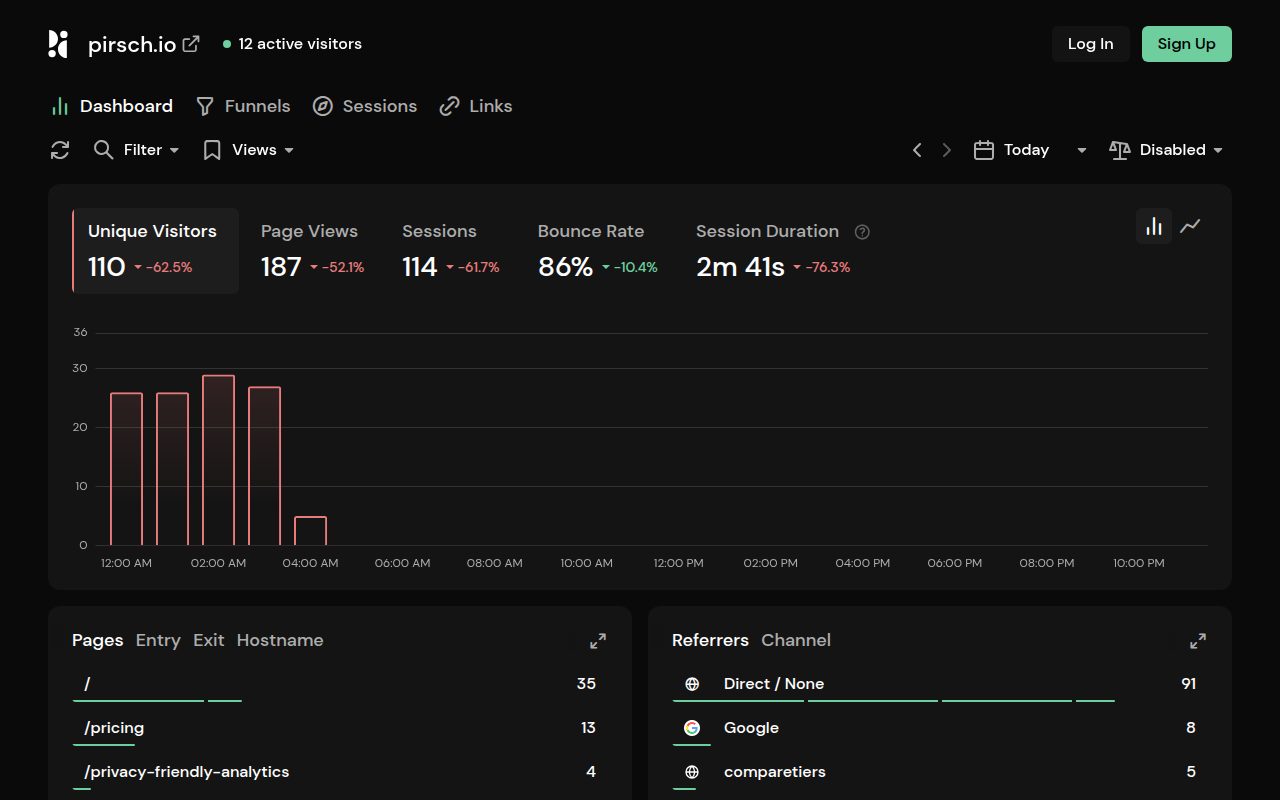
What it does
- Filterable one-page dashboard with saved views and session summaries
- Fifty websites and unlimited members on Standard
- Funnels, revenue, teams and white-labeling on Plus
- Automated email reports and private dashboard links
- API, server-side tracking and historical imports
Pros
- Unusually generous site and member allowances for the starting price
- Strong client-reporting and white-label options on Plus
- Cookie-free tracking with data stored in Germany
- Imports from Google Analytics, Plausible and Fathom
Cons
- An unresolved overage stops collection after five days
- Events and optional session keep-alive requests consume the page-view allowance
- Funnels, revenue and teams require Plus rather than Standard
Skip if: Sites with unpredictable traffic that cannot monitor and upgrade before an overage interrupts collection.
Umami Cloud is the best free starting point for a small site that wants more than page and referrer counts. The Hobby plan includes 100,000 monthly events for one website, with six months of history (as of November 2026). It also includes the core funnels, goals, campaign, journey, retention, revenue and reports that connect conversions to marketing sources that other services often reserve for paid tiers.
Those reports make Umami a more capable marketing tool than Fathom and a more affordable one than Plausible Business. They also create more to learn: custom dashboards, breakdowns, cohorts and journey reports ask the reader to understand more analytics concepts than a one-page summary requires. Plausible is the better recommendation when a client will read the dashboard unaided.
Pro costs $20 a month and includes one million events, 20 websites, ten team members, two years of history, API access and email reports. Estimate event usage before choosing between Umami and a page-view plan. A page view or custom event counts once, and every property saved with an event counts again. For example, one signup event stored with three properties consumes four event units. Extra Pro events have a published per-event charge, and collection continues when you pass the included amount. A monthly spending budget can instead stop recording once estimated costs reach your chosen limit.
Migration and departure are unusually well covered. Pro includes vendor-assisted imports from CSV exports and self-hosted Umami databases; Umami names Google Analytics, Plausible and Matomo among its migration sources. It also provides a full underlying-data export rather than only summarized dashboard reports. The free plan omits imports and API access, and its six-month history cannot support a year-over-year comparison.
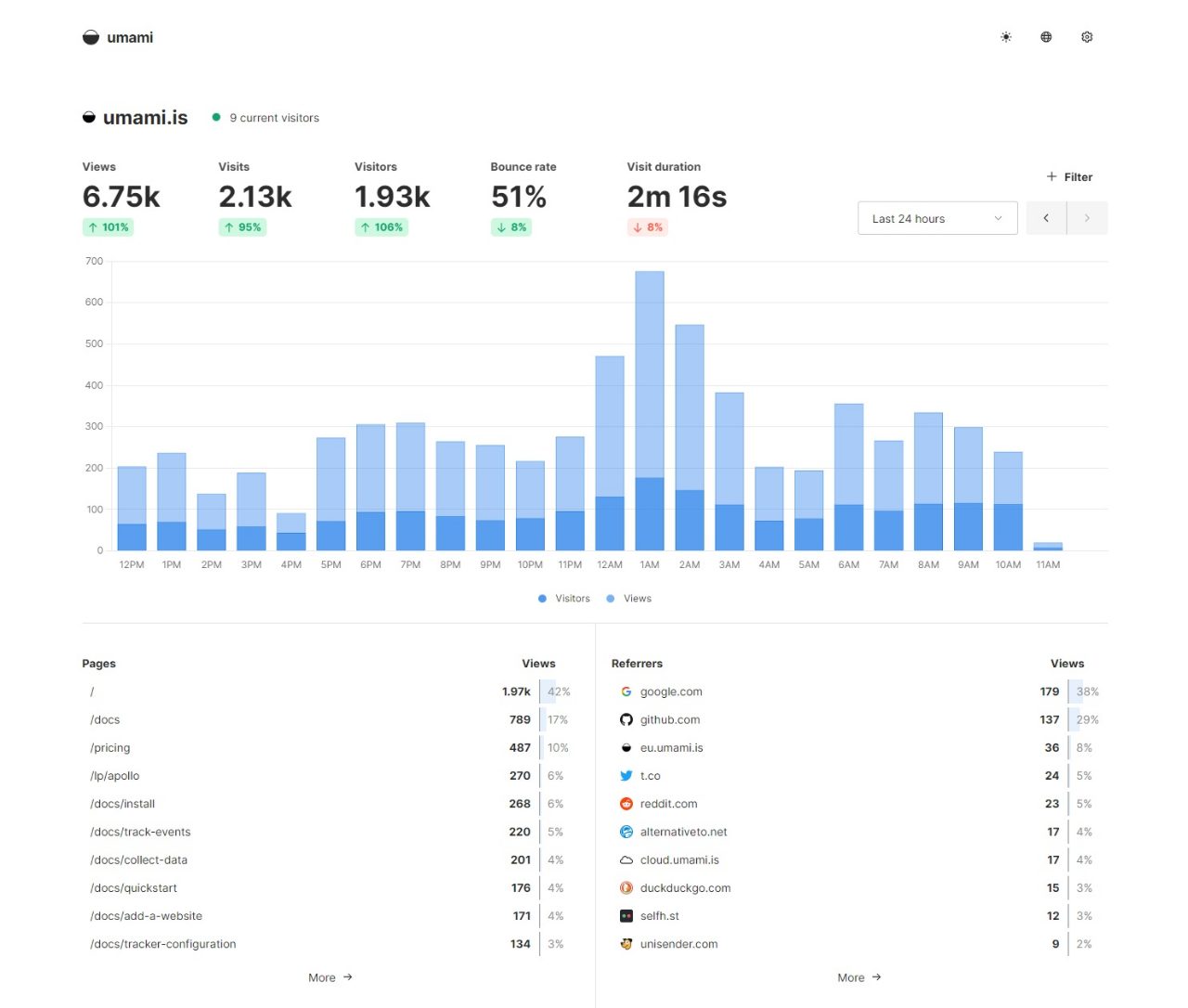
What it does
- Traffic, campaign, goal, funnel, journey and revenue reports
- Free Hobby plan with 100,000 monthly events
- Pro supports 20 sites, ten members, API and email reports
- Full data export and vendor-assisted imports on Pro
- Realtime activity, custom dashboards and public share links
Pros
- Permanent free plan includes advanced conversion reports
- Full underlying-data export reduces lock-in
- Broad acquisition, retention, revenue and conversion-source analysis
- Paid plans continue collecting beyond their included event allowance unless you set a spending-budget stop
Cons
- Every saved event property adds to the billed event count
- Hobby retains only six months of history and has no import or API
- Email reports and team access require a paid plan
- More report types and concepts to learn than Plausible or Fathom
Skip if: Nontechnical clients who need the simplest possible dashboard, or anyone tracking many event properties on a tight budget.
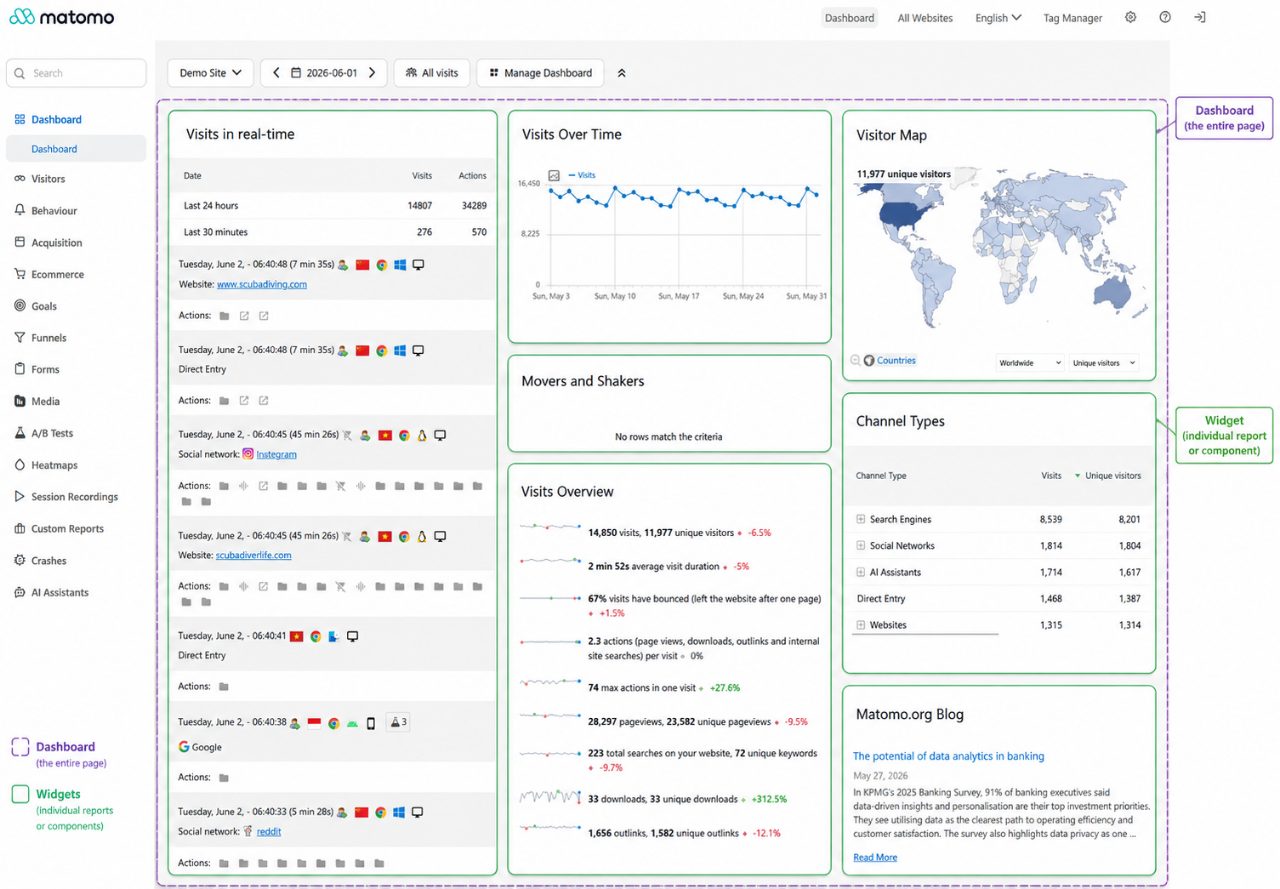
Matomo Cloud is for a marketing team that finds the other dashboards too narrow. Alongside traffic sources and campaigns, its hosted plans include funnels, user flows, ecommerce, custom reports and dimensions, segmentation, cohorts, conversion credit across marketing channels and roll-up reporting across sites. Matomo also supports visitor-level APIs, a Google Analytics importer and scheduled email reports.
This is an important difference from Matomo On-Premise: advanced capabilities that appear as paid plugins in the self-hosted product are included in the Cloud subscription. Matomo Cloud’s Business plan starts at $26 a month before tax (as of November 2026), with 30 websites and 30 team members. Heatmaps and session recordings have separate monthly usage allowances, while raw visitor data is kept for 24 months and report data indefinitely.
The same breadth makes Matomo the hardest service here for a casual reader. An owner who wants a weekly summary of popular pages and successful campaigns will face far more menus, settings and specialist terms than Plausible or Fathom presents. Matomo earns its higher price when you already need those specialist reports, not merely because its feature list is longer.
Matomo stores Cloud data in Frankfurt, Germany, but its default tracking uses first-party cookies. Cookie-free tracking and use without a consent banner are possible only after configuring Matomo and meeting its documented privacy conditions. The other ranked services avoid analytics cookies by default. Matomo also counts page views, events, downloads, outbound clicks and other tracking requests as billable hits, so its traffic allowance cannot be compared directly with a page-view figure.
What it does
- Custom reports, funnels, user flows, cohorts and conversion-source analysis
- Ecommerce, campaign and real-time visitor reports
- Thirty websites and 30 team members on Business
- GA import, visitor-level API and Cloud-to-On-Premise migration
- Frankfurt data storage and scheduled email reports
Pros
- Deepest marketing and ecommerce reporting in this ranking
- Cloud includes features sold separately as On-Premise plugins
- Generous website, team, goal and segment allowances
- No report-data sampling and indefinite report retention
Cons
- Broad interface and vocabulary are excessive for basic traffic reporting
- Cookies are the default; consent-free tracking needs configuration
- Higher entry price than the simpler hosted services
- Raw data retention is limited to 24 months on Business
Skip if: Owners who want a simple weekly traffic summary without configuring privacy settings or learning a full analytics suite.
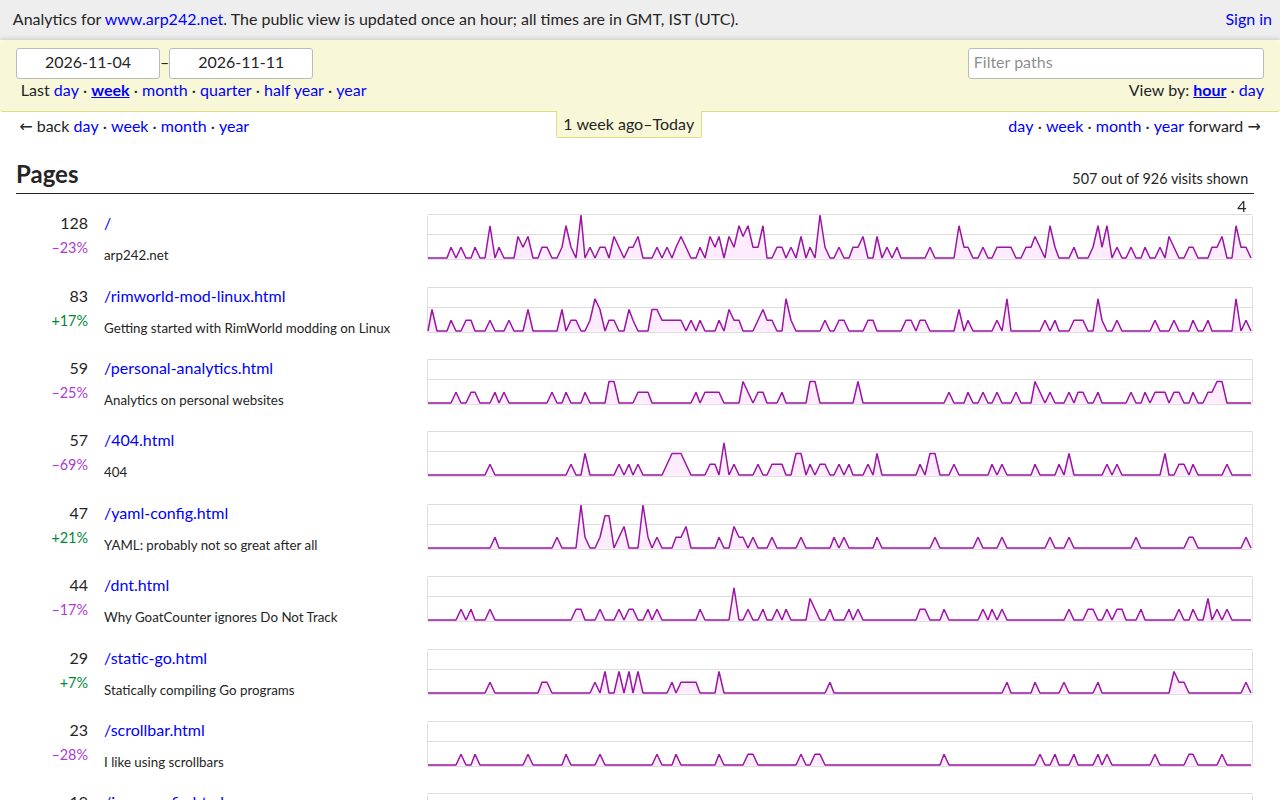
GoatCounter is a good fit for a blog, documentation site or small business that mainly wants to know which pages people read and which sites or campaigns sent them. Its hosted service is free for reasonable public usage, explicitly including personal sites and small-to-medium businesses. Donations pay for the servers. The interface also has an explicit commitment to working well with screen readers.
It offers unusually flexible collection for a free hosted tool. Besides the normal script, GoatCounter can count visits through an image when JavaScript is unavailable, receive page views from your website’s backend, or import web-server logs. Every individual page view can be exported as CSV, and its API exposes both statistics and site management.
The reports are deliberately basic. Custom events and campaign parameters are available, but GoatCounter does not provide the funnel analysis and reports connecting revenue to marketing sources that Umami, Plausible or Matomo offers. Choose it to understand readership rather than to manage an ecommerce marketing program. Umami’s free plan is the better fit when conversion reports matter.
GoatCounter’s operating terms also need more judgment than a normal price tier. It is not intended for millions of daily page views, and the project suggests self-hosting for heavier or more demanding use. Separate domains normally need separate GoatCounter sites, with no standard all-sites dashboard to unite them. Those limits are reasonable for a donation-supported service, but an agency or a business that needs a committed capacity plan should choose a paid provider.
What it does
- Page, referrer, campaign, browser and location reports
- Free donation-supported hosting for reasonable public usage
- Script, image, backend and server-log collection
- Full page-view CSV export and statistics API
- Read-only users, shared dashboards and screen-reader support
Pros
- Useful website statistics without a subscription
- Accessible, restrained interface without Matomo's complexity
- Several ways to count visits when JavaScript is unavailable
- Complete page-view export and cookie-free operation from Ireland
Cons
- No funnel, revenue or reports that connect conversions to marketing sources
- Reasonable-use terms do not provide a defined high-traffic allowance
- Separate domains lack a standard combined dashboard
- GA imports do not populate the dashboard's historical reports
Skip if: Agencies and marketing teams that need client reporting, conversion analysis or a committed traffic allowance.
Choose around your traffic and your readers
Start with who will read the reports and how much analysis they need. A one-page dashboard makes routine questions easier to answer, while Umami’s journeys and retention reports reward a reader willing to explore. Matomo’s breadth is worth the extra learning only when you already know which custom report, way of assigning conversion credit or ecommerce question the simpler tools cannot answer.
Match the bill to the way your site behaves. For a small site with few custom events, the starting prices above are useful guides. Heavy event tracking changes the arithmetic: a signup, download or outbound click can consume part of the same allowance as a page view. Umami’s separate charge for every saved event property can make a seemingly generous event allowance shrink quickly. Matomo’s hits include still more kinds of requests.
Overage handling matters just as much as the monthly figure. Plausible tolerates a one-off spike; Umami Pro keeps collecting and charges for extra events unless you set a spending budget that stops recording at its limit; Fathom gives reminders before restricting dashboard access. Pirsch has the least forgiving cutoff. A site whose traffic can jump after a newsletter or news mention needs allowance for that spike, not just its average month.
For an agency, the number of included sites is only part of the decision. Check whether clients should explore a live dashboard or receive selected sites in a recurring email, whether you need your own branding, and how much each additional site costs. Umami Business removes site and member limits but costs substantially more than Pro.
Migration can decide between otherwise similar services. Plausible and Fathom import GA4 history, although Fathom’s imported reports are more limited. Umami Pro offers vendor-assisted imports and a complete export, Matomo can move data between Cloud and On-Premise, and Pirsch imports from Plausible and Fathom as well as Google Analytics. If leaving with every individual event matters, Umami is the safest ordinary-plan choice; Plausible’s ordinary plans export aggregated reports, while scheduled event-level exports require Enterprise.
Finally, read the privacy claim as a description of data handling, not a guarantee about your whole website. Plausible and Pirsch document EU analytics storage; Matomo stores Cloud data in Frankfurt but uses cookies by default. GoatCounter operates from Ireland without giving an equally specific storage-location commitment. Fathom stores anonymized analytics in the US, and Umami uses US and EU servers. Other scripts on your site and any information you add to custom events can change your consent obligations.
Scores
1–5 per criterion · select a score for its reasoning and any sources| # | Product | Overall | Clear everyday reports , counts double | Cost for normal website use , counts double | Marketing and conversion reports | Privacy and hosting | Sites and client reporting | Migration and data access | Fair usage and retention |
|---|---|---|---|---|---|---|---|---|---|
| 1 | Plausible Analytics | 4.0 | 5 | 3 | 4 | 5 | 3 | 3 | 5 |
| 2 | Pirsch Analytics | 4.0 | 4 | 4 | 3 | 5 | 5 | 4 | 3 |
| 3 | Umami | 4.0 | 3 | 5 | 4 | 4 | 3 | 5 | 4 |
| 4 | Fathom Analytics | 3.9 | 5 | 3 | 2 | 4 | 5 | 4 | 4 |
| 5 | GoatCounter | 3.2 | 3 | 5 | 1 | 5 | 2 | 3 | 2 |
| 6 | Matomo | 3.1 | 2 | 2 | 5 | 3 | 4 | 4 | 4 |
Equal displayed overall scores are ordered by the earlier criteria; a known score comes before an unknown score. Identical scores use alphabetical order.
×2 = counts double in the overall score, ×½ = counts half.
How each criterion is scored
Clear everyday reports
Counts double in the overall score: Most buyers want colleagues or clients to understand routine website reports without hiring an analyst; this is the primary everyday benefit.
How readily a business owner, publisher or client can use the managed dashboard to answer what people read, where visitors came from and whether a campaign led to a conversion. Judge the report organization, filtering and how much analytics knowledge the reader needs; the number of available reports alone does not make a dashboard clearer.
- 5 An exceptionally legible dashboard gives non-specialists the main traffic and campaign answers at a glance
- 4 A well-organized dashboard answers routine questions with useful filters and little training
- 3 Routine reports are understandable but take some learning or several report screens
- 2 Dense or awkward navigation makes routine traffic and campaign answers hard to find
- 1 Important traffic answers require expert configuration or custom report building
Cost for normal website use
Counts double in the overall score: Price decides whether small businesses and publishers can adopt and keep a managed service; unusually generous site allowances count separately.
The ongoing managed-service cost for a small business or publisher, considering the entry price, whether a permanent free plan exists and how much ordinary website traffic and conversion tracking the allowance covers. Compare billing units and plan restrictions rather than treating a pageview, event and hit as universally identical. Multi-site value is scored separately under collaboration.
- 5 A permanent free hosted service suitable for real small-business or publisher use
- 4 Affordable managed reporting with a useful allowance for a typical small site
- 3 A reasonable paid entry price, but no permanent free plan or a tight basic allowance
- 2 Paid only, with a high entry cost or a restrictive allowance for ordinary traffic
- 1 A comparatively expensive subscription for modest website reporting needs
Marketing and conversion reports
The useful depth available in the ordinary self-serve managed plans for website acquisition and business outcomes: campaign/UTM reporting, custom events and goals, funnels or journey analysis, segmentation and custom reporting, and ecommerce revenue or attribution. Score what a buyer can actually obtain without a custom enterprise contract, and name a required higher self-serve tier in the rationale.
- 5 Broad, customizable acquisition, funnel, ecommerce and attribution reporting for specialist marketing teams
- 4 Funnels, journeys or customizable segments alongside campaigns and revenue
- 3 Goals, campaign and revenue reporting, plus some filtering or journey analysis
- 2 Events or goals and campaign reports, but no funnel, journey or revenue analysis
- 1 Mainly page, referrer and basic campaign counts, with little conversion analysis
Privacy and hosting
How little visitor data the managed service collects by default, whether its normal setup avoids analytics cookies, and how clearly the vendor documents the processing and storage location. A stronger level combines cookie-free tracking with no persistent personal identifiers and storage wholly within the EU. This scores product behavior, not a legal guarantee for every website.
- 5 Cookie-free without persistent personal identifiers, with visitor data stored in the EU
- 4 Cookie-free without persistent personal identifiers, but anonymized data is stored in the US or across US/EU regions
- 3 Documented settings can avoid cookies or personal data, but the default needs privacy configuration
- 2 Cookies or personal-data storage are the default, with limited regional control
- 1 Cross-site tracking or advertising identifiers are central to the default service
Sites and client reporting
How well ordinary managed plans handle several websites and the people who need reports: included sites and users, view-only or client access, shared dashboards, automated email reports and white-label or multi-site options. Consider the cost and plan required for an agency with many small client sites, not just whether a feature exists somewhere.
- 5 Many sites and users with strong multi-site, client and white-label workflows at an accessible price
- 4 A generous multi-site allowance with client access, email reports and useful roles
- 3 Several sites and shared dashboards or email reports on a self-serve plan
- 2 A few sites or basic sharing, but client/team access quickly raises the cost
- 1 One site or one user, with no practical way to share reports
Migration and data access
How easily a managed customer can bring historical website analytics from Google Analytics or another provider, query or export reports, and take underlying data to another service. Direct imports, full exports and useful APIs on ordinary plans earn more than report-only downloads or enterprise-only raw data.
- 5 Broad historical imports and complete, accessible underlying-data export without an enterprise contract
- 4 Historical imports and useful API/export options on self-serve plans
- 3 A direct historical import or full data export, plus ordinary report exports or API access
- 2 Basic report export or API, with no useful historical import
- 1 No practical historical import and only limited manual report downloads
Fair usage and retention
What happens when website traffic exceeds the plan allowance, and how much history the ordinary managed plan retains. Prefer continued data collection, clear and predictable charges or upgrade rules, and enough retention for year-over-year comparisons. Free reasonable-use services are judged by their stated operating limits, not given an invented SLA.
- 5 Forgiving overage handling with no surprise interruption and unrestricted history while subscribed
- 4 Clear overage charges or upgrade rules preserve collection, with useful long-term history
- 3 Collection survives ordinary spikes, but unresolved overages restrict access or retention is limited
- 2 Strict usage caps, short retention or unclear operating limits can disrupt normal use
- 1 An overage quickly stops collection or makes important historical reports inaccessible
Also considered
- Simple Analytics
Its clean, EU-hosted dashboard is appealing, but its self-serve plan starts at $20 a month and includes only one user, with additional users costing $20 each a month. Fathom and Pirsch cover many more sites and team workflows for less, while Plausible offers deeper marketing reports. The free hobby plan requires a Simple Analytics badge and retains only 30 days of history, so Umami is the stronger free business option.
Questions
Is hosted analytics less likely to be blocked than self-hosted analytics?
No. Where the vendor stores analytics does not determine whether a visitor’s browser blocks the tracking request. The address that receives that request and the visitor’s blocker matter more. Plausible, Umami and Pirsch can receive tracking through your website’s domain rather than a visibly separate analytics domain. GoatCounter can instead collect visits from your website’s backend or server logs. These approaches can reduce missed visits, but none guarantees complete counts.
Sources
6 products
Sources used for scores and product facts.