
Omni Analytics
Cloud BI platform whose AI agent answers questions through a governed semantic model
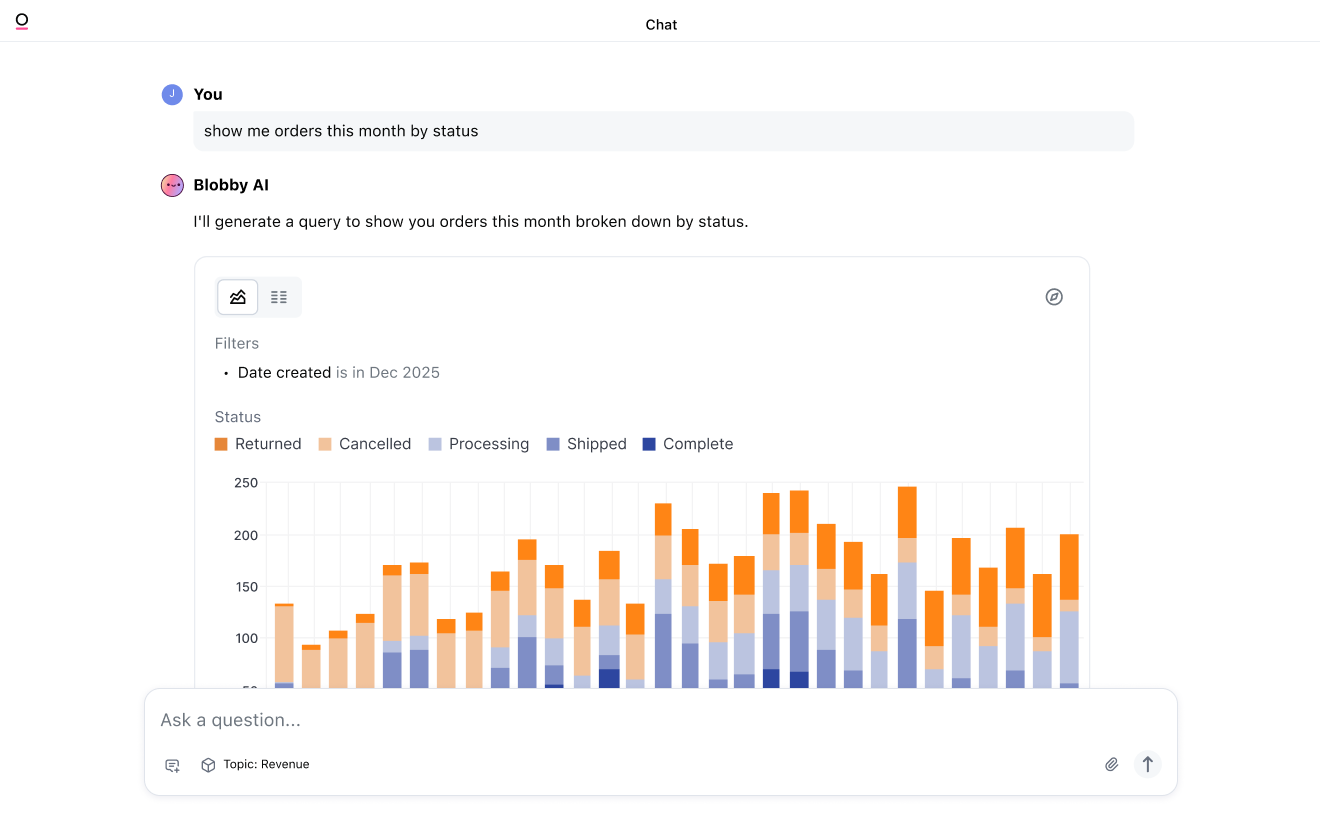
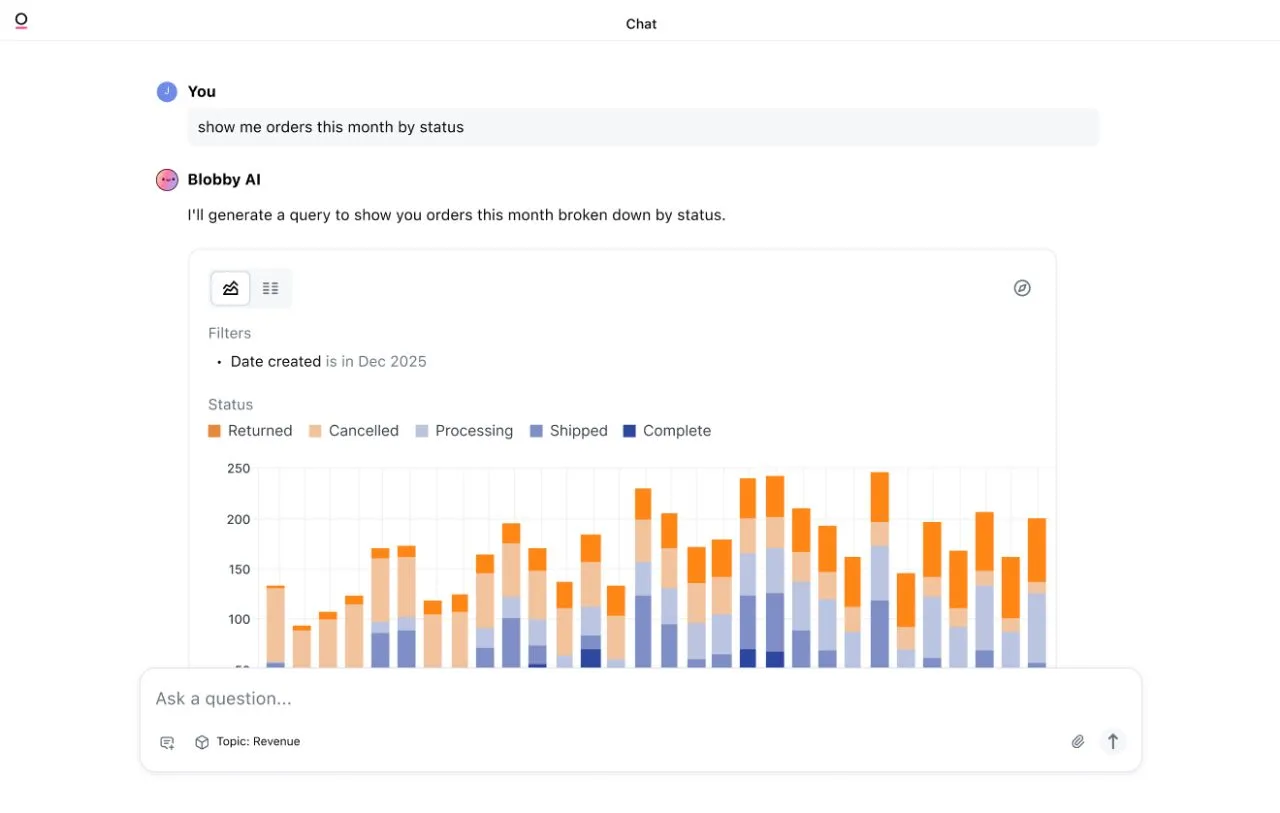 (opens full size in a new tab)
Facts
- Price
- Contact sales
- Runs on
- Web
- Needs
- A SQL data warehouse or database such as SnowflakeBigQueryDatabricksRedshift or PostgreSQL
- Category
- AI
- Facts checked
Price checked · Current prices on vendr.com ↗
Our verdict
#5 of 10 in AI data analysis tools
Governed BI with SQL you can open
What it does
- AI agent that answers through Omni's semantic model
- SQL for each answer opens in an editable workbook
- Python statistics and forecasts on query results
- Slack agent, MCP server, and scheduled Routines
Pros
- Metric definitions and row-level permissions apply to every AI answer
- Mixes point-and-click, SQL, and spreadsheet-style work in one place
- No training on customer data
Cons
- Price only through a sales quote
- Needs a well-built semantic model before the AI is reliable
About Omni Analytics
Omni is a cloud business intelligence platform from former Looker engineers that combines a governed semantic model with point-and-click exploration, SQL, spreadsheet-style workbooks and dashboards. Its AI agent takes plain-language questions in chat, in workbooks, on dashboards, in Slack and through an MCP server. It builds semantic queries from the model, runs them as SQL against the connected warehouse, and can write Python for statistics and forecasting, with the SQL and code open to inspection. It is aimed at teams with a data warehouse and a data team to maintain the model, and is sold as a subscription by quote.
What users say
Omni's own materials and its customers' case studies credit the semantic model for the AI's accuracy. Two reviews from competing vendors, Knowi and Querio, make the same point as a warning, saying that gaps in the model carry straight into AI answers and that the model needs steady upkeep. Both are single vendor-written pieces, not user surveys, and neither reports a test of its own. No public accuracy benchmark was found.
4 quotes from users and reviewers
Omni's AI does its best work when the semantic layer in business intelligence under it is in good shape. If that layer has gaps, the AI picks them up too. So the job doesn't disappear. It changes. Instead of writing every query by hand, analysts spend time checking the system's assumptions.
querio.ai/articles/omni-review-honest-look-after-hype · published · checked Omni is not a “set and forget” tool. When metrics, joins, or business logic change, the model layer has to change too.
querio.ai/articles/omni-review-honest-look-after-hype · published · checked There isn't a public benchmark that measures Omni on standardized churn, conversion, follow-up, or ambiguous-query tests.
querio.ai/articles/omni-review-honest-look-after-hype · published · checked Omni’s AI does well because it’s backed by a structured data model. Now, it’s easier for us to train it like we would teach an analyst — giving it the right context to understand our business language and definitions.
Heidi, Omni customer quoted in Omni's own case study · omni.co/ai · checked
Ranked in
-
#5 of 10 AI data analysis tools Governed BI with SQL you can open 3.6/5
How it scored
-
Correct answers , counts double 4/5
Answers come from semantic queries translated to SQL and run on the warehouse, grounded in a team-curated model with evals; accuracy claims are the vendor's and no independent benchmark exists.
4/5 means: Runs SQL or code grounded in shared definitions a team curates (a semantic model, verified queries or endorsed tables), with reported mistakes mainly on data nobody curated
The AI does not generate raw SQL directly from text; we found that this process can produce inconsistent results. Instead, the AI generates “semantic queries” through Omni’s semantic layer, which defines metrics, dimensions, joins, access controls, and AI-specific instructions.
omni.co/ai · checked Omni translates the semantic query into SQL, runs it against your database, and returns the results to the AI to interpret for the user. You can always view the SQL used for AI responses by opening the query in a workbook.
omni.co/ai · checked Yes. Evals in Omni’s AI Hub measure how accurately Omni’s AI answers the questions your team asks. Build a prompt set from those real questions and run it against your model, and a built-in accuracy judge scores every response pass or fail with a written explanation.
omni.co/ai · checked There isn't a public benchmark that measures Omni on standardized churn, conversion, follow-up, or ambiguous-query tests.
querio.ai/articles/omni-review-honest-look-after-hype · published · checked
Show all 4
-
Shows its work 4/5
SQL for AI answers opens in a workbook where it can be edited, and Python code and logs are viewable; saved reproducibility is not documented in what I read.
4/5 means: Shows the query or code and lets the analyst edit or rerun it in place
Omni translates the semantic query into SQL, runs it against your database, and returns the results to the AI to interpret for the user. You can always view the SQL used for AI responses by opening the query in a workbook.
omni.co/ai · checked When a question needs statistics, forecasting, or machine learning, the Omni Agent writes Python and runs it on your governed query results or an uploaded spreadsheet. You can open the code and logs of every step to check the work.
omni.co/ai · checked Build queries with a prompt, and switch into point/click, SQL, or spreadsheets at any point.
omni.co/ai · checked
-
Depth of analysis 4/5
The agent does multi-step analysis and writes Python for statistics and forecasting on query results or uploaded spreadsheets, in chat; joins across files and tables in one analysis were not confirmed.
4/5 means: Python with statistics, forecasting and joins across files or tables, inside a chat
Omni’s AI is an agentic system that can reason through complex questions. At its core is a coordinator mechanism that plans actions, selects tools, executes queries, evaluates results, and decides what to do next.
omni.co/ai · checked When a question needs statistics, forecasting, or machine learning, the Omni Agent writes Python and runs it on your governed query results or an uploaded spreadsheet. You can open the code and logs of every step to check the work.
omni.co/ai · checked
-
Connects to your data 4/5
Native Snowflake, BigQuery, Databricks, Redshift, Postgres and more, plus spreadsheet upload for the agent; cannot join across warehouses, and upload limits and Google Sheets support are unknown.
4/5 means: Most major warehouses and databases natively, with files, though one answer works on one connection or model at a time
When a question needs statistics, forecasting, or machine learning, the Omni Agent writes Python and runs it on your governed query results or an uploaded spreadsheet. You can open the code and logs of every step to check the work.
omni.co/ai · checked Omni connects to SQL data warehouses and databases: Snowflake, Google BigQuery, Databricks, Amazon Redshift, PostgreSQL, ClickHouse, Trino, MySQL, MotherDuck, and Microsoft SQL Server.
knowi.com/blog/omni-analytics-review · checked Teams with MongoDB, Elasticsearch, or multi-source data stacks will hit a hard wall: Omni requires everything in a SQL warehouse before it can query it, and cannot join across data sources without first centralizing them.
knowi.com/blog/omni-analytics-review · checked
-
Sharing with the team 5/5
Interactive dashboards and apps, scheduled Routines, a Slack agent, and viewer-level access; the plan that includes each was not found.
5/5 means: Interactive dashboards or apps, scheduled delivery, Slack or Teams, and separate access for people who only view
The Omni Slack Agent brings your governed data into the conversation. Mention @Omni, ask in plain language, and get a trusted answer right in the thread.
omni.co/ai · checked Routines let you write a prompt once and run it on a schedule, through your governed semantic model.
omni.co/ai · checked
-
Security and data governance 4/5
No training on customer data, with row-level filters and user attributes in the model applied to every AI query; permissions are defined in Omni rather than inherited from the warehouse.
4/5 means: No training, SOC 2 and admin controls, plus shared definitions or per-user data permissions set in the tool or its connections
Since data permissions and row-level filters live in the semantic layer, the proper security measures are enforced via user attributes on every query. Even when using AI, users only have access to the data they should.
omni.co/ai · checked Your data is never used to train models. Organizations can also configure Anthropic Direct, Google Vertex AI, OpenAI, Snowflake Cortex, or Grok (xAI).
docs.omni.co/ai · checked When AI features are toggled on, only necessary data is shared with external LLMs. For example, when asking AI to generate queries, or write formulas, only query metadata (column names, sorts, limits, etc.) is shared. If asking AI to summarize a query, then the results set is shared.
omni.co/ai · checked
-
Price per analyst 1/5
No published pricing; plans are sold by sales quote, so this is the highest-cost level. Third-party estimates ($50-$65 per user per month, a $15 snippet) conflict.
1/5 means: Price only through a sales quote
Omni does not publish pricing. All plans require a demo call with their sales team.
knowi.com/blog/omni-analytics-review · checked Omni does not publish public pricing, so treat it like a sales-led purchase. Judge it on three-year total cost of ownership, not on a per-seat number. One G2 review snippet mentions paying around $15 per user per month, but that's only an anecdotal data point, not a verified list price. The same reviewer also said it felt expensive for many occasional users.
querio.ai/articles/omni-review-honest-look-after-hype · published · checked
-
Works without a data team 2/5
Answer quality rests on a curated semantic model that a data team maintains, and setup is said to take weeks; the sources are competitor reviews and Omni's own advice, and a solo analyst on raw tables was not tested.
2/5 means: A data team must model or curate the data first; an analyst alone gets unreliable answers
Omni's AI does its best work when the semantic layer in business intelligence under it is in good shape. If that layer has gaps, the AI picks them up too. So the job doesn't disappear. It changes. Instead of writing every query by hand, analysts spend time checking the system's assumptions.
querio.ai/articles/omni-review-honest-look-after-hype · published · checked Omni is not a “set and forget” tool. When metrics, joins, or business logic change, the model layer has to change too.
querio.ai/articles/omni-review-honest-look-after-hype · published · checked Setup also tends to take weeks, not days.
querio.ai/articles/omni-review-honest-look-after-hype · published · checked
Top of this ranking
- Hex #1
- Claude #2
- ThoughtSpot #3
-



Sources
26 quotes from 5 pages; the 13 most useful are below.
-
Pricing 4
Omni does not publish pricing. All plans require a demo call with their sales team.
knowi.com/blog/omni-analytics-review · checked Median buyer pays $27,976 per year Based on data from 37 purchases.
vendr.com/marketplace/omni-analytics · checked Omni charges per user, with different license types (e.g., creator, explorer, viewer) priced at different rates.
vendr.com/marketplace/omni-analytics · checked Omni does not publish public pricing, so treat it like a sales-led purchase. Judge it on three-year total cost of ownership, not on a per-seat number. One G2 review snippet mentions paying around $15 per user per month, but that's only an anecdotal data point, not a verified list price. The same reviewer also said it felt expensive for many occasional users.
querio.ai/articles/omni-review-honest-look-after-hype · published · checked
-
Limits and known issues 3
Track adoption, answer quality, and credit usage across your organization.
docs.omni.co/ai · checked Teams with MongoDB, Elasticsearch, or multi-source data stacks will hit a hard wall: Omni requires everything in a SQL warehouse before it can query it, and cannot join across data sources without first centralizing them.
knowi.com/blog/omni-analytics-review · checked Omni’s AI layer uses third-party LLMs, including Claude and ChatGPT, behind its semantic layer. The semantic layer governs what the AI can query, but the language model processing happens on Anthropic or OpenAI’s infrastructure. Omni does not offer an on-premises deployment option.
knowi.com/blog/omni-analytics-review · checked
-
What users say 2
Omni’s AI does well because it’s backed by a structured data model. Now, it’s easier for us to train it like we would teach an analyst — giving it the right context to understand our business language and definitions.
Heidi, Omni customer quoted in Omni's own case study · omni.co/ai · checked Omni's AI does its best work when the semantic layer in business intelligence under it is in good shape. If that layer has gaps, the AI picks them up too. So the job doesn't disappear. It changes. Instead of writing every query by hand, analysts spend time checking the system's assumptions.
querio.ai/articles/omni-review-honest-look-after-hype · published · checked
-
Features 3
Omni’s AI is an agentic system that can reason through complex questions. At its core is a coordinator mechanism that plans actions, selects tools, executes queries, evaluates results, and decides what to do next.
omni.co/ai · checked The AI does not generate raw SQL directly from text; we found that this process can produce inconsistent results. Instead, the AI generates “semantic queries” through Omni’s semantic layer, which defines metrics, dimensions, joins, access controls, and AI-specific instructions.
omni.co/ai · checked Your data is never used to train models. Organizations can also configure Anthropic Direct, Google Vertex AI, OpenAI, Snowflake Cortex, or Grok (xAI).
docs.omni.co/ai · checked
-
How widely it is used 1
Omni had a 4.8/5 rating from 65 G2 reviews as of January 2026
querio.ai/articles/omni-review-honest-look-after-hype · published · checked