
Kiro
AWS's coding agents for structured development across IDE, terminal and web
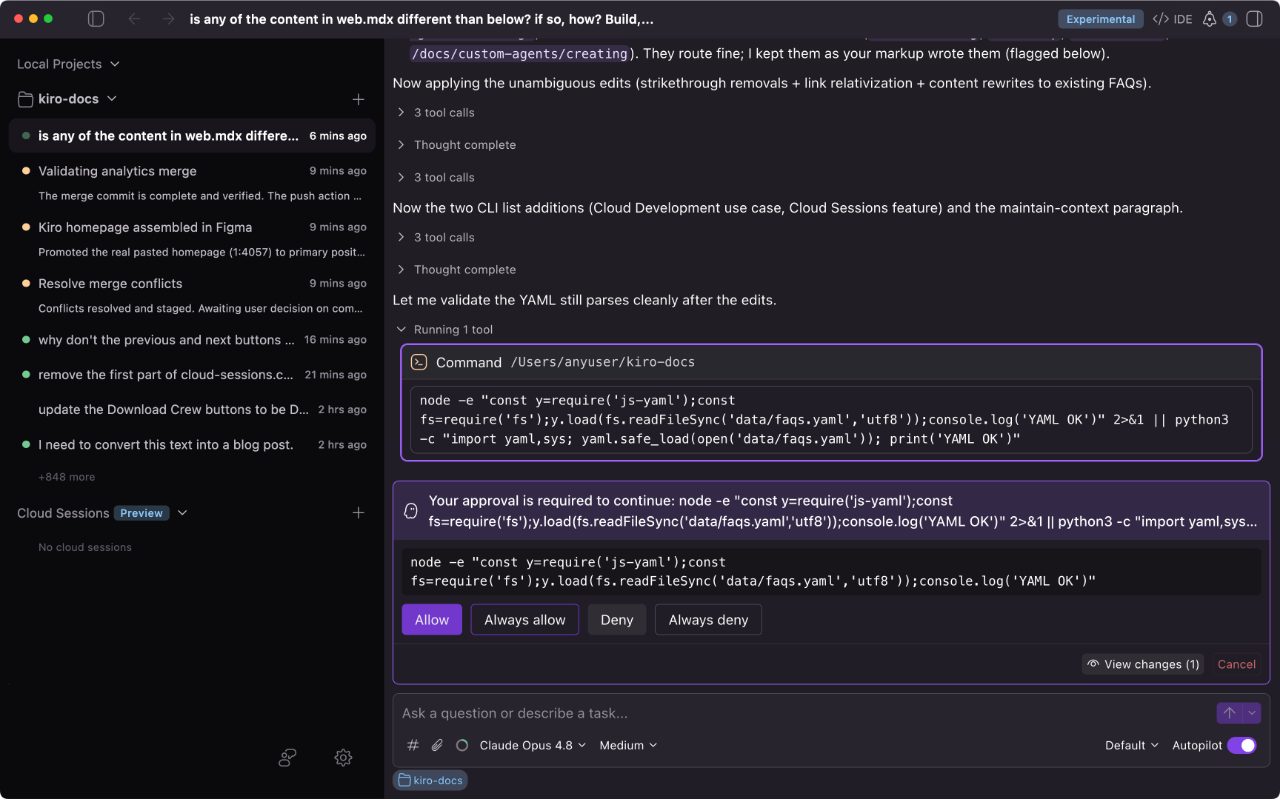
Our verdict
#5 of 7 in AI code editors · For specification-first development
Pros
- The clearest specification-driven AI development workflow
- Useful planning and verification, with requirements, design, and task documents the team can read
- A recurring free allowance and broad curated model menu
Cons
- Too much process for small or exploratory changes
- Credit use varies with the task and selected model
- Individual content collection is on by default until you opt out
Skip if: Developers who need local models or a custom provider, or who need predictable per-prompt credit costs.
Rankings and alternatives
- #5 of 7 AI code editors For specification-first development
- Cursor #1 Best overall for hands-on AI coding
- Visual Studio Code #2 For compatibility and a choice of agents
- IntelliJ IDEA #3 For Java and Kotlin teams



AI code editors scores
Evaluated Nov 12, 2026 Evidence ↓- AI coding quality · counts double 4
4/5 means: Strong predictive and multi-file assistance, with a meaningful limitation on complex work or in the editor's implementation
Strong specification, implementation and verification structure for substantial features, with several current frontier and open-weight model choices. Its process is valuable when requirements matter, but it adds overhead and its completed spec is not itself proof of correct code.
- Editor quality 3
3/5 means: A capable main editor with evident performance, reliability or tooling tradeoffs
A complete Code OSS editor with familiar settings, debugging and compatible extensions. It is serviceable for direct coding, but its core editing experience does not match JetBrains' semantic depth or Zed's native performance, and reviewer reports of friction temper its suitability as a general default.
- Integrated AI workflow · counts double 4
4/5 means: A cohesive manual-and-AI workflow with one significant rough edge or an opinionated interface that will not suit everyone
Quick sessions, quick specs and full specs let developers choose how much structure to use, with requirements, design, tasks and code review in one environment. The opinionated spec process is excellent for its target audience but more ceremony than small or exploratory changes need.
- Review and change control 4
4/5 means: Strong review and recovery with a specific limitation in the available controls or their consistency
Reviewable requirements and design artifacts, per-change diffs, parallel task execution, sandboxes and property-based tests offer strong control over substantial work. Verification differs by interface, with property-based correctness testing specific to the IDE.
- Compatibility with existing workflows 4
4/5 means: Broad compatibility and migration with a recognizable ecosystem or platform limitation
Cross-platform and able to import VS Code settings, themes and Open VSX plugins. It fits familiar projects without promising the entire proprietary VS Code marketplace or JetBrains' integrated language tools.
- Model and agent choice 3
3/5 means: Several providers or an external-agent route, with meaningful plan, compatibility or setup restrictions
A broad current menu spans OpenAI, Anthropic and open-weight models, with automatic routing. The models run through Kiro's service and credit system rather than a general custom-provider or local-inference route.
- Learning resources and support 3
3/5 means: Adequate documentation and community help, with important AI or editor questions requiring specialist knowledge
Code OSS conventions and current specifications documentation give readers a clear path through quick and structured work. The newer editor has fewer established project examples and troubleshooting discussions, and its specification model adds concepts beyond a familiar VS Code setup.
- Privacy and team controls 3
3/5 means: Useful no-training options or administration, with important defaults, retention or identity limitations
Enterprise users get no-training terms and administrators get detailed pooled-credit controls. Free and individual-subscriber content collection is on by default until the user opts out, while retention and inference location vary by account and model.
Pricing
- Free Free 50 monthly credits with open-weight models and limited Claude Sonnet access
- Pro $20.00 /month 1,000 monthly credits; add-on credits cost $0.04 each
From the vendor’s pricing page, checked Nov 12, 2026. That page is authoritative.
Evidence and sources
AI code editors scores
AI coding quality 4 quotes
-
“Every spec generates three key files that form the foundation of your specification: requirements.md (or bugfix.md) - Captures user stories, acceptance criteria, or bug analysis in structured notation design.md - Documents technical architecture, sequence diagrams and implementation considerations tasks.md - Provides a detailed implementation plan with discrete, trackable tasks”
kiro.dev/docs/specs · checked -
“Capability IDE CLI Web Mobile Feature Specs ✓ ✓ ✓ — Bugfix Specs ✓ ✓ ✓ — Quick Spec ✓ ✓ ✓ — Parallel task execution ✓ ✓ ✓ — Analyze Requirements ✓ ✓ — — Correctness (property-based testing) ✓ — — —”
kiro.dev/docs/specs · checked -
“Kiro gives you access to frontier and open weight AI models from OpenAI, Anthropic, and other providers.”
kiro.dev/docs/models · checked -
“Jump straight into an agent session for quick fixes. Use quick spec to clarify your intent before you build. Or run a full spec-driven flow to surface architectural tradeoffs and define constraints before parallel agents build.”
kiro.dev/ide · checked
Editor quality 2 quotes
-
“Available on macOS, Windows, and Linux. Get started for free.”
kiro.dev/ide · checked -
“Kiro is based on Code OSS, so you can [import your VS Code settings, themes, and Open VSX compatible plugins] in the Kiro onboarding flow.”
kiro.dev/ide · checked
Integrated AI workflow 2 quotes
-
“Every spec generates three key files that form the foundation of your specification: requirements.md (or bugfix.md) - Captures user stories, acceptance criteria, or bug analysis in structured notation design.md - Documents technical architecture, sequence diagrams and implementation considerations tasks.md - Provides a detailed implementation plan with discrete, trackable tasks”
kiro.dev/docs/specs · checked -
“Jump straight into an agent session for quick fixes. Use quick spec to clarify your intent before you build. Or run a full spec-driven flow to surface architectural tradeoffs and define constraints before parallel agents build.”
kiro.dev/ide · checked
Review and change control 2 quotes
-
“Every spec generates three key files that form the foundation of your specification: requirements.md (or bugfix.md) - Captures user stories, acceptance criteria, or bug analysis in structured notation design.md - Documents technical architecture, sequence diagrams and implementation considerations tasks.md - Provides a detailed implementation plan with discrete, trackable tasks”
kiro.dev/docs/specs · checked -
“Capability IDE CLI Web Mobile Feature Specs ✓ ✓ ✓ — Bugfix Specs ✓ ✓ ✓ — Quick Spec ✓ ✓ ✓ — Parallel task execution ✓ ✓ ✓ — Analyze Requirements ✓ ✓ — — Correctness (property-based testing) ✓ — — —”
kiro.dev/docs/specs · checked
Compatibility with existing workflows 2 quotes
-
“Available on macOS, Windows, and Linux. Get started for free.”
kiro.dev/ide · checked -
“Kiro is based on Code OSS, so you can [import your VS Code settings, themes, and Open VSX compatible plugins] in the Kiro onboarding flow.”
kiro.dev/ide · checked
Model and agent choice 1 quote
-
“Kiro gives you access to frontier and open weight AI models from OpenAI, Anthropic, and other providers.”
kiro.dev/docs/models · checked
Learning resources and support 5 quotes
-
“Kiro is based on Code OSS, so you can [import your VS Code settings, themes, and Open VSX compatible plugins] in the Kiro onboarding flow.”
kiro.dev/ide · checked -
“Every spec generates three key files that form the foundation of your specification: requirements.md (or bugfix.md) - Captures user stories, acceptance criteria, or bug analysis in structured notation design.md - Documents technical architecture, sequence diagrams and implementation considerations tasks.md - Provides a detailed implementation plan with discrete, trackable tasks”
kiro.dev/docs/specs · checked -
“Capability IDE CLI Web Mobile Feature Specs ✓ ✓ ✓ — Bugfix Specs ✓ ✓ ✓ — Quick Spec ✓ ✓ ✓ — Parallel task execution ✓ ✓ ✓ — Analyze Requirements ✓ ✓ — — Correctness (property-based testing) ✓ — — —”
kiro.dev/docs/specs · checked -
“Kiro | 365 | 2.8%”
survey.stackoverflow.co/2026/technology/data/dev-ide · checked -
“Jump straight into an agent session for quick fixes. Use quick spec to clarify your intent before you build. Or run a full spec-driven flow to surface architectural tradeoffs and define constraints before parallel agents build.”
kiro.dev/ide · checked
Privacy and team controls 2 quotes
-
“By default, Kiro collects usage data, errors, crash reports, and other metrics as well as content for service improvement from Kiro Free Tier users and Kiro individual subscribers.”
kiro.dev/docs/privacy-and-security/data-protection · checked -
“Administrators can organize users into groups, assign them to credit pools, and set usage limits for individuals, groups, and profiles. They maintain visibility on user credit, pool credit, and seat utilization via dashboards and get alerts when utilization levels reach 80% and 100% so that they can purchase add-on credits.”
kiro.dev/pricing · checked
Facts
License 1 quote
-
“The Kiro IDE and Kiro CLI are each licensed to you as “AWS Content” under the AWS Customer Agreement or other written agreement with us governing your use of AWS services, and the AWS Intellectual Property License.”
kiro.dev/license · checked
Runs on 2 quotes
-
“Available on macOS, Windows, and Linux. Get started for free.”
kiro.dev/ide · checked -
“Kiro CLI is a tool that allows you to interact with Kiro’s AI agents directly from your terminal. The CLI enables you to use AI for tasks like writing, reviewing, modifying code, and automating workflows, locally or in cloud sessions that persist across disconnects.”
kiro.dev/cli · checked
Needs 1 quote
-
“Log in with GitHub, Google, AWS Builder ID, or AWS IAM Identity Center. You do not need an AWS account to use Kiro.”
kiro.dev/ide · checked
Other quotes
Not cited by a score or fact 3 quotes
-
“KIRO FREE $0 per month 50 credits Access to open weight models and Claude Sonnet 4.5”
kiro.dev/pricing · checked -
“KIRO PRO $20 per user / month 1,000 credits Access to premium models Add-on credits ($0.04/credit)”
kiro.dev/pricing · checked -
“A credit is a unit of work in response to user prompts. Simple prompts can consume less than 1 credit. More complex prompts, such as executing a spec task, typically cost more than 1 credit. Additionally, different models consume credits at different rates, with a prompt executed via Sonnet 4.6 costing more credits than executing it with Auto.”
kiro.dev/pricing · checked
Pricing
kiro.dev/pricing · checked