AI presentation makers, ranked

Ask these tools for “a ten-slide pitch for our new loyalty program” and they can draft the slides for you. The differences show up afterward: how much of the text you rewrite, how many layouts you nudge back into place, and what happens when someone asks you for the PowerPoint file.
That last one catches a lot of people. The tools with the prettiest drafts, Gamma and Canva, build decks in their own editors, and when you export to PowerPoint the slides arrive as loose text boxes on blank layouts. That makes it harder to apply a company template across the deck. The AI built into PowerPoint and Google Slides makes plainer slides, but keeps them in the editor your team already uses.
For most people, Gamma is the best AI presentation maker to start with: its drafts look the most designed of anything here, the free plan already exports to PowerPoint and Google Slides, and the paid plan is $9 a month on an annual plan. If the deck has to live in PowerPoint on a company template, use Copilot in PowerPoint instead, which you may already have through Microsoft 365.
First decide where the deck will live
- You’ll present from the tool or send a link. Gamma for most decks. Pitch or Beautiful.ai if you’re a sales team that wants to see who opened the deck.
- It has to be a PowerPoint file on a company template. Copilot in PowerPoint. Plus AI on Enterprise if you don’t have Copilot or also work in Google Slides, or Claude’s PowerPoint add-in on a paid Claude plan.
- Your team works in Google Slides. Gemini in Google Slides if your company is on Workspace Business Standard or higher; Plus AI if it isn’t.
- You already design everything else in Canva. Canva, so the deck shares a brand kit with your social posts and handouts.
- You won’t pay anything. Claude’s free plan includes its Slides tool, Canva’s free plan includes a small AI allowance, and Gamma gives you a one-time batch of credits.
- You already pay for ChatGPT or Claude. Try that first. Claude makes the more designed deck; ChatGPT is stronger at the outline than the look.
The PowerPoint problem is easy to see in practice. When a PowerPoint trainer, Taylor Croonquist, ran the same prompt through ChatGPT, Copilot, Gamma and Canva and opened each file in PowerPoint, Copilot’s deck was the one built on placeholders (the template’s built-in spaces for titles, text and images), which you can restyle across the deck from the slide master. Gamma’s and Canva’s looked better but sat on blank layouts, and ChatGPT’s was all text.
| Tool | Free start | Paid from |
|---|---|---|
| Gamma | 400 one-time credits, with export | $9/month |
| Canva | Small monthly AI allowance | $12/month |
| Copilot in PowerPoint | None | $99.99/year (Microsoft 365 Personal) |
| Beautiful.ai | 14-day trial, card needed | $14.50/month |
| Pitch | 500 one-time credits, no PowerPoint export | €10/month per seat |
| Claude | Claude Slides within free usage limits | $17/month |
| Plus AI | 7-day trial, card needed | $10/month |
| Gemini in Google Slides | None | $14/month per user (Workspace) |
| Prezi | 500 credits, presentations are public | $19/month for unlimited AI |
| ChatGPT | Limited use of the PowerPoint add-in | $20/month (Plus) |
Monthly prices are for annual billing unless noted.

Gamma
Best-looking drafts for most decks
#1 4.2/5
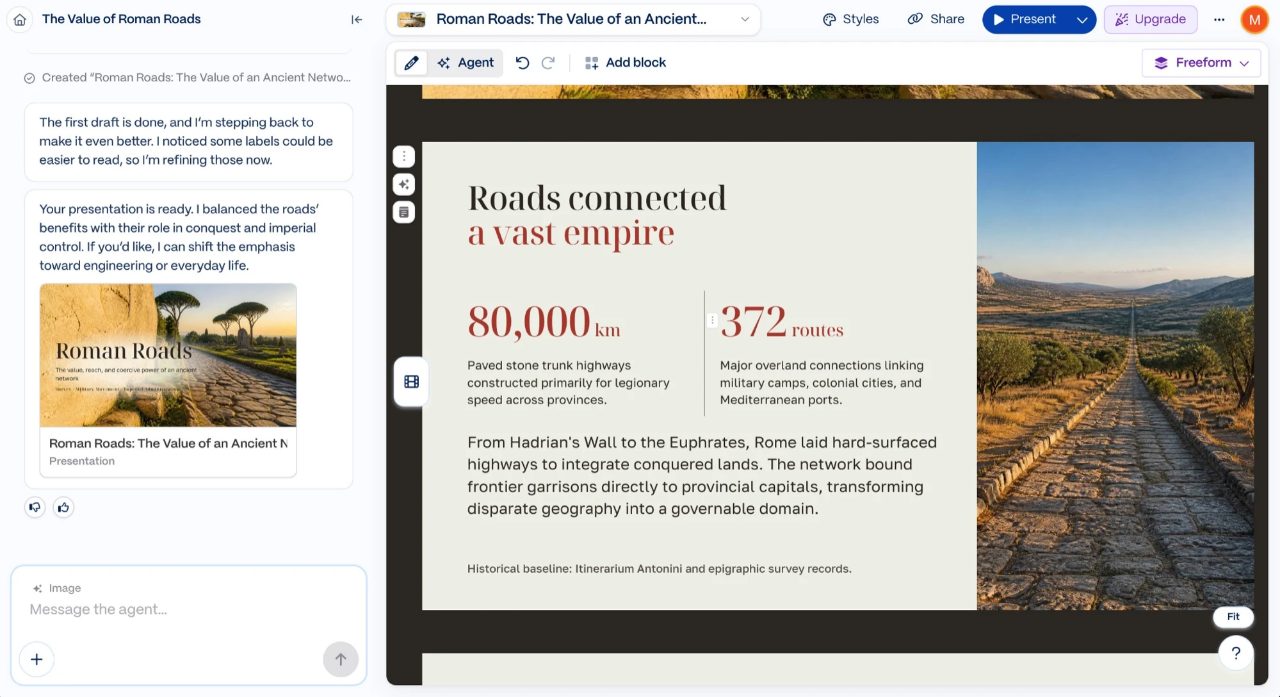
Gamma is the one to try first if you mostly need a deck that looks good in front of people. You type a topic or paste your notes, and before it builds anything it asks who the audience is, what tone you want and how much text belongs on each slide. Then it shows the outline as cards you can reorder or delete, and the deck streams in with a theme picked for the subject and images tinted to match the palette. The drafts rarely have the crowded, all-bullets look that gives AI decks away.
You can revise one slide without rebuilding the deck. A chat panel takes requests like “make slide four less wordy,” a row of smart layouts swaps a list into columns or a timeline, and a freeform mode lets you drag anything anywhere. You can also import a PowerPoint or PDF and have Gamma redesign it, or pull material from Notion, Slack and other connected tools.
Where Gamma falls short is the handoff. Gamma’s decks are meant to be presented from Gamma or shared as a link (Pro adds viewer analytics). The PowerPoint and Google Slides exports work on every plan, but the slides lose their structure, so a team that has to restyle the file on its own template will spend a while redoing it in PowerPoint. The free plan’s 400 credits are a one-time grant that doesn’t refill, decks carry a Gamma badge until you pay, and on individual plans Gamma may use your content to train its AI unless you switch that off in settings. There’s no mobile app, so editing on a phone means the browser.
What it does
- Asks about audience, tone and text density, then shows an editable outline before building
- Edit by chat, with smart layouts, or freeform
- Imports PowerPoint and PDF files and pulls content from connected tools
- Presents and shares as a link, with viewer analytics on Pro
Pros
- The most polished, least template-looking first drafts here
- PowerPoint and Google Slides export even on the free plan
- Plus is $9 a month with 1,500 credits that roll over
Cons
- Exported PowerPoint slides sit on blank layouts with no placeholders
- Free credits are one-time and decks carry a Gamma badge
- Individual plans may train on your content unless you opt out
- Skip if:
- Your deck must be restyled on a company PowerPoint template

Canva
For decks that share a brand kit with your other designs
#2 3.9/5
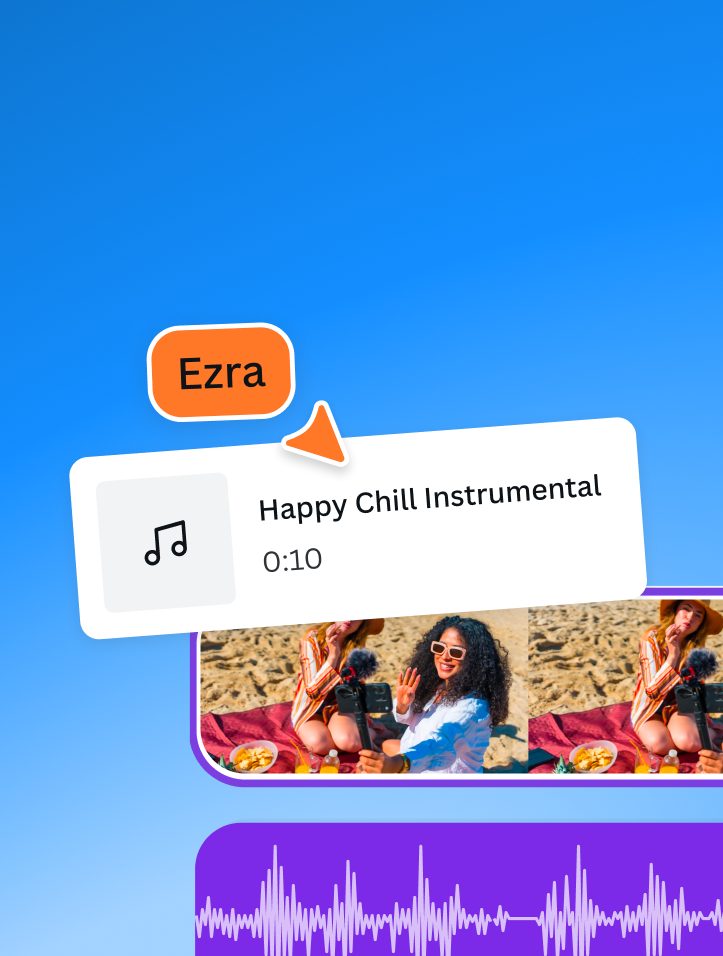
Canva makes the most sense if you already design in it. Ask Canva AI for a presentation and it hands you a few designed options, and once you pick one you’re in the same drag-and-drop editor you use for social posts, with your brand kit, Magic Write for rewording and a chat that suggests design fixes. The deck can turn into a handout, a LinkedIn carousel or a short video without leaving Canva, and presenting is polished: presenter view, your phone as a remote, offline presenting and recording.
The weak part is the writing. Geekflare’s reviewer estimated that Canva’s AI text needs 50 to 70 percent rewriting for professional use, and the layouts come from a template library so popular that people may recognize them. Compared with Gamma, Canva gives you the better editor and the wider design toolkit, and Gamma gives you the better draft. Exports to PowerPoint have the same blank-layout problem as Gamma’s.
Pro costs $144 a year ($12 a month) and raises the AI allowance tenfold. K-12 schools and nonprofits get most premium features free, which makes Canva the easy pick in many classrooms.
What it does
- Generates designed deck options from a prompt, then opens them in the full Canva editor
- Brand kits, Magic Write and AI image generation
- Presenter view, phone remote, offline presenting and recording
Pros
- One of the most flexible editors here, and familiar to millions of people
- Free for K-12 schools and nonprofits, and the free plan's AI allowance renews
- One deck can become a handout, a social post or a video
Cons
- AI-written slide text is generic and needs heavy rewriting
- Template-based layouts can look familiar
- PowerPoint exports land on blank layouts
- Choose if:
- Your school or nonprofit already has free Canva premium

Copilot in PowerPoint
For decks that must stay in PowerPoint
#3 3.7/5
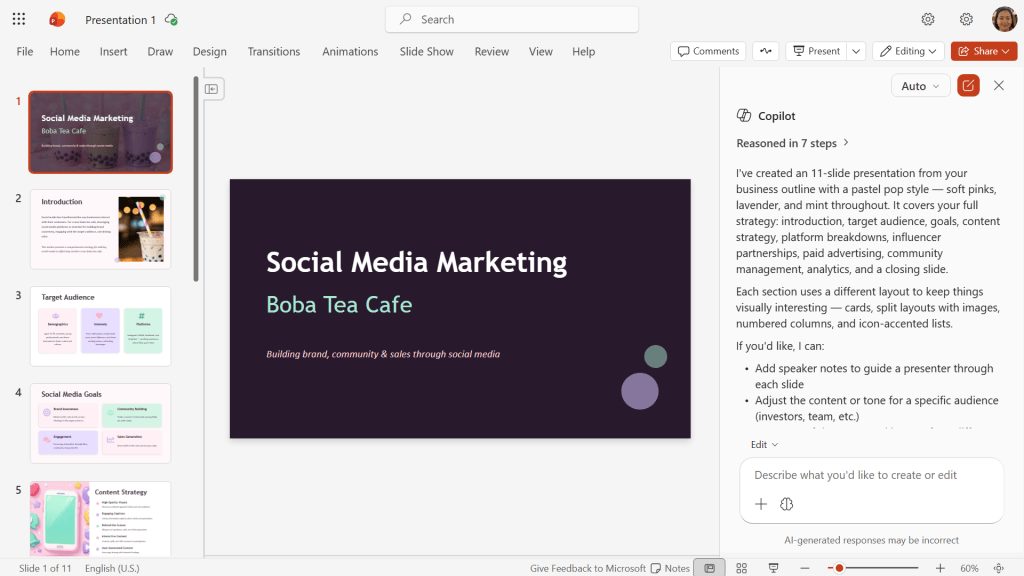
Copilot lives in a sidebar inside PowerPoint, and that’s its whole advantage. Ask for a deck, or attach a Word document, spreadsheet or PDF, answer a couple of follow-up questions, and it builds the slides in the open file. If your marketing team has set up a branded template, open it first and Copilot uses its layouts, so the result is a normal PowerPoint deck your colleagues can edit, restyle from the slide master and present the usual way. It’s also good at the edits that come after: adding a transition slide between two others, condensing a wordy text box, or tightening the whole deck.
The slides themselves look plainer than Gamma’s or Canva’s. They’re tidy and consistent, closer to a well-chosen built-in theme than to a designed deck. For a quarterly review on the company template, that’s exactly right; for a pitch you want people to remember, it’s a step down.
Copilot in PowerPoint comes with Microsoft 365 Personal ($99.99 a year), Family and Premium, with monthly AI limits that are higher on Premium. On Family only the subscription owner gets it. At work, the Microsoft 365 Copilot Business add-on is $21 per user per month with yearly billing; smaller organizations may already have limited Copilot in the Office apps, so ask IT before you buy anything. There’s no free way in.
What it does
- Builds a deck from a prompt or an attached Word, Excel or PDF file
- Uses a company's branded template and its layouts
- Agent mode adds, rewrites and reorganizes slides in the open deck
Pros
- Real PowerPoint slides with placeholders, ready for the slide master
- Included with Microsoft 365 Personal, which also gets you the Office apps
- Good at turning a structured document into a sensible deck
Cons
- Plainer design than the dedicated deck makers
- No free option; on Family plans only the owner gets Copilot
- Skip if:
- You want a striking design and nobody needs the PowerPoint file

Beautiful.ai
Layouts that rearrange themselves
#4 3.6/5
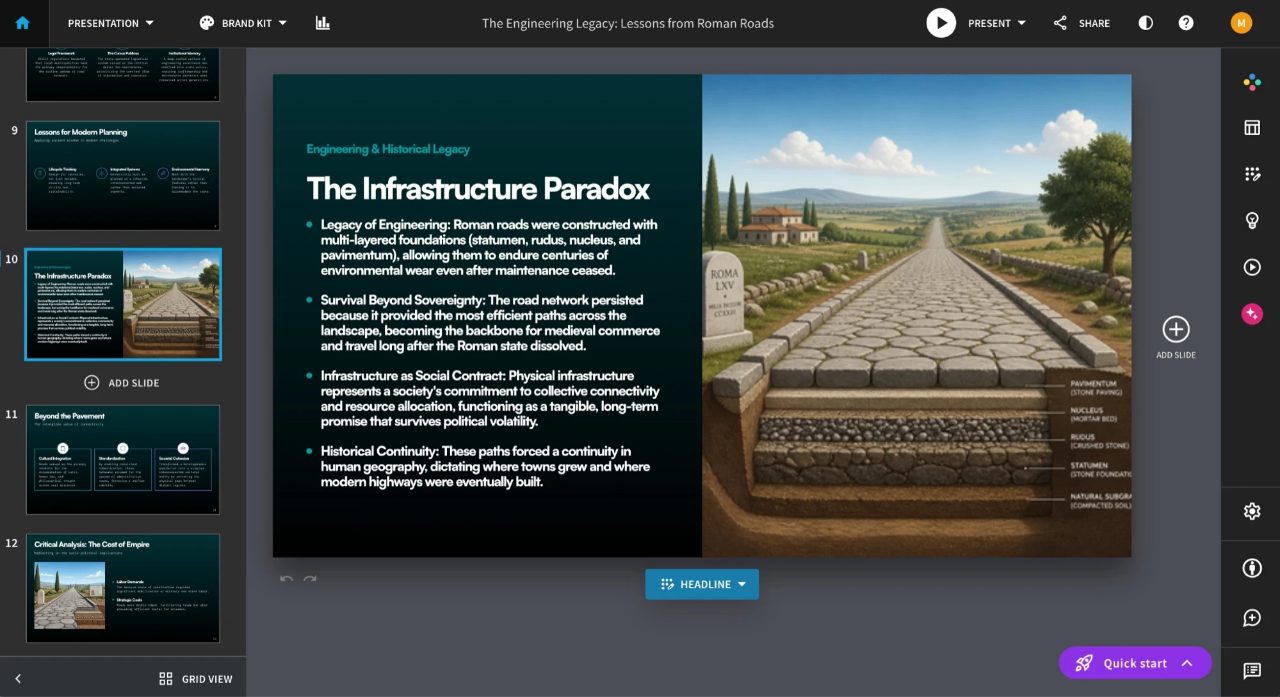
Beautiful.ai handles the alignment for you. Its Smart Slides reflow as you type: add a fourth point to a three-column slide and the columns resize, drop in a bigger number and the chart rebalances. The AI drafts from a topic, an outline or your files after you review the outline, and a layout panel previews other ways to show the same slide with your words and numbers kept intact. It suits recurring report decks, where the data changes every month and the layout should keep up.
The drafts lean on text and charts rather than big images, and Smart Slides trade some freedom for that tidiness (Classic Slides are there when you want to place things yourself). PowerPoint export works but drops animations and audio, and the self-arranging layouts become ordinary shapes.
There’s no free plan. The 14-day trial needs a card, Pro is $14.50 a month billed annually, or $45 month to month for a one-off project, and students with a .edu email get a year free. The Team plan ($40 per user per month) adds locked slides, shared slide and asset libraries, and analytics showing who viewed which slides.
What it does
- Smart Slides that resize and realign as content changes
- Previews alternative layouts for a slide while keeping its content
- Unlimited AI generation on every plan
Pros
- Decks stay neat with no manual alignment
- Strong team controls: locked slides, shared libraries, viewer analytics
- A free year for students with a .edu email
Cons
- No free plan, and the trial needs a card
- Drafts lean on text and data slides
- PowerPoint exports lose animations, audio and the auto-layout
- Choose if:
- You rebuild the same report deck every month

Pitch
For sales teams that track who opened the deck
#5 3.6/5
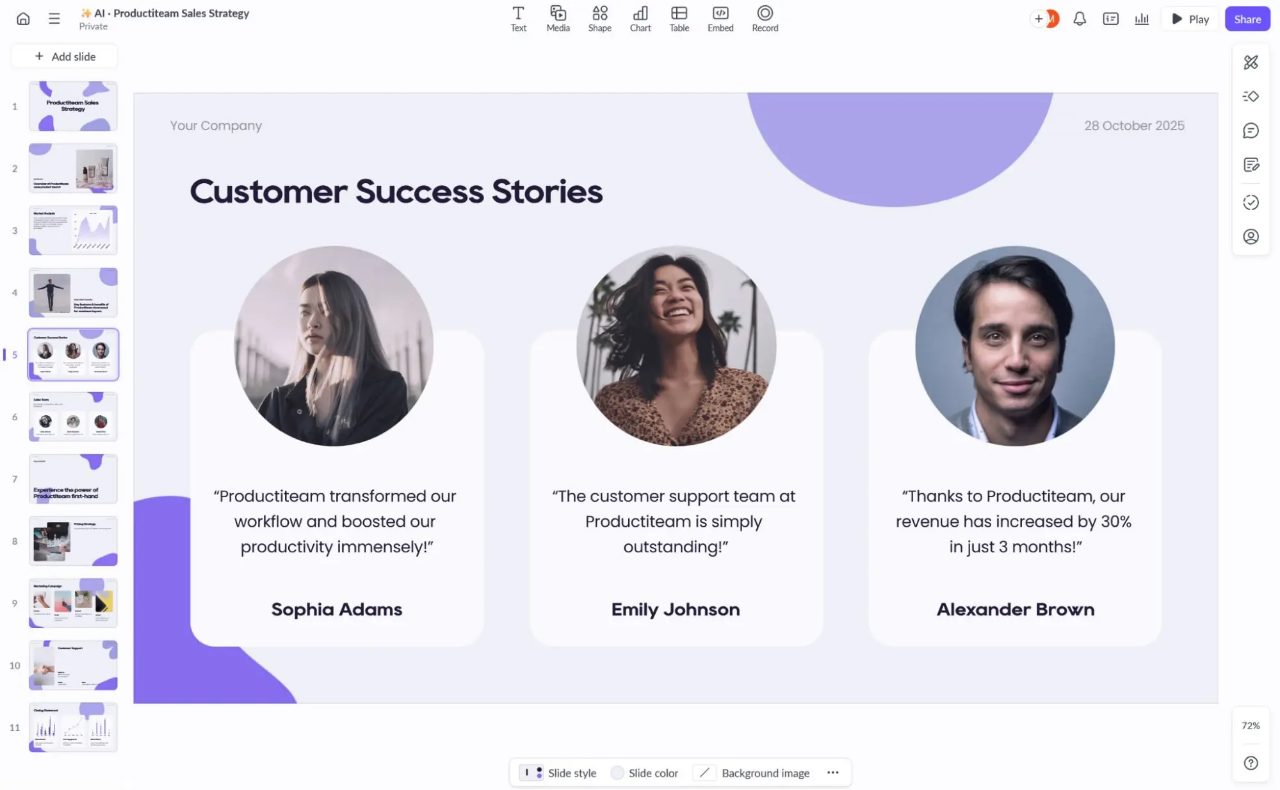
Pitch is built for teams that sell. Its AI drafts in the shape of a sales conversation (the prospect’s problem, the market, your answer), which is great for a client deck and awkward for a history lesson. Teammates edit together in real time, custom templates and fonts keep everyone on brand, and charts can pull live numbers from Google Sheets, HubSpot or Google Analytics. Tracked links help with follow-up: on the Team and Business plans you can see visits, which slides people viewed and how long they lingered.
Next to Beautiful.ai, which also tracks viewers, Pitch is the better place to build a deck together and track sales follow-up, while Beautiful.ai is better at keeping each slide tidy without effort. Pitch prices are in euros: the free plan for up to five people has 500 AI credits that don’t renew and no PowerPoint export, and Plus is €10 per seat per month, paid yearly.
What it does
- AI drafts structured like a sales pitch
- Real-time co-editing with custom templates and fonts
- Tracked links with slide views and time on each slide
- Live data from Google Sheets, HubSpot and Google Analytics
Pros
- Clean, consistent design out of the box
- Tracks views of each slide, which helps sales follow-up
Cons
- AI is shaped for sales decks and fits other topics poorly
- No PowerPoint export on the free plan, and free AI credits don't renew
- Skip if:
- You're making a class or conference talk

Claude
Designed decks on a free plan
#6 3.5/5
Claude, Anthropic’s chat assistant, is the surprise here. Its Slides tool turns your notes, an uploaded report or the conversation so far into a designed deck in the chat window, and you can then click into a slide and edit it, leave a comment on one element, or just ask for changes. You present from Claude or export to PowerPoint, Google Slides or PDF. It comes with every plan, Free included, within the plan’s usage limits, which makes it a strong free option if you’d rather not sign up for yet another tool.
The drafts look good and the ideas are often sharp, but expect marketing language and plenty of flowcharts. You may need to simplify both for a class or internal update. On paid plans (Pro is $17 a month billed annually), the Claude for PowerPoint add-in builds slides inside PowerPoint from a company template’s layouts and makes native, editable charts. Claude does little for teams: no shared brand kits and no viewer tracking.
What it does
- Claude Slides drafts a deck from notes, files or a conversation
- Edit slides directly, by comment or by chat
- Exports to PowerPoint, Google Slides and PDF
- Claude for PowerPoint add-in on paid plans works from your company template
Pros
- Designed decks on the free plan, with export
- Good at turning messy notes into a clear story
Cons
- Default wording and layouts lean toward marketing style
- Few team features and no viewer analytics
- Choose if:
- You already pay for Claude and want to skip another subscription

Plus AI
AI inside Google Slides and PowerPoint
#7 3.5/5
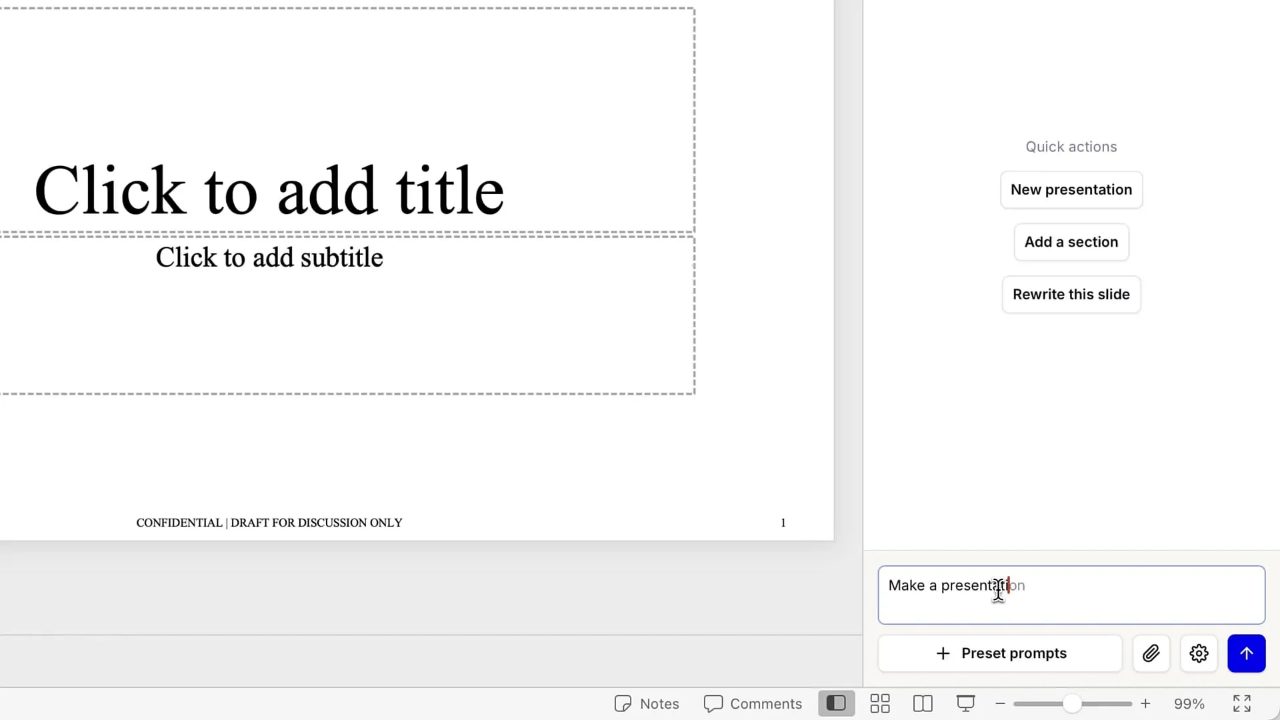
Plus AI installs as an add-on in Google Slides and an add-in in PowerPoint, and one subscription covers both. It drafts a deck from a prompt or an uploaded PDF, Word file or deck right in the presentation you have open, so every slide is an ordinary slide from the start. Its remix feature changes an individual slide: select a slide and turn a paragraph into three columns, or rewrite the text in place, without touching the rest.
It’s the natural choice for a Google Slides team without Gemini, or for anyone who bounces between Slides and PowerPoint. Read the plan list closely, though. Basic is $10 a month, billed yearly, but can’t build from uploaded documents (that’s Pro, at $20), brand colors and fonts need Team ($30), and generating from your company’s own slide masters is Enterprise only. There’s no free plan; the 7-day trial needs a card. The slides look clean and businesslike, though less polished than Gamma’s.
What it does
- Generates and edits slides inside Google Slides and PowerPoint
- Builds from uploaded PDF, Word, PowerPoint and text files (Pro and up)
- Rewrites and remixes a chosen slide's layout
Pros
- Native slides in both apps from one subscription
- No export step, so nothing breaks on the way into PowerPoint or Slides
Cons
- Document uploads, branding and company templates sit on pricier plans
- No free plan; the trial needs a card
- Choose if:
- Your team uses Google Slides but doesn't have Gemini's deck generation

Gemini in Google Slides
For teams already on Google Workspace
#8 3.4/5
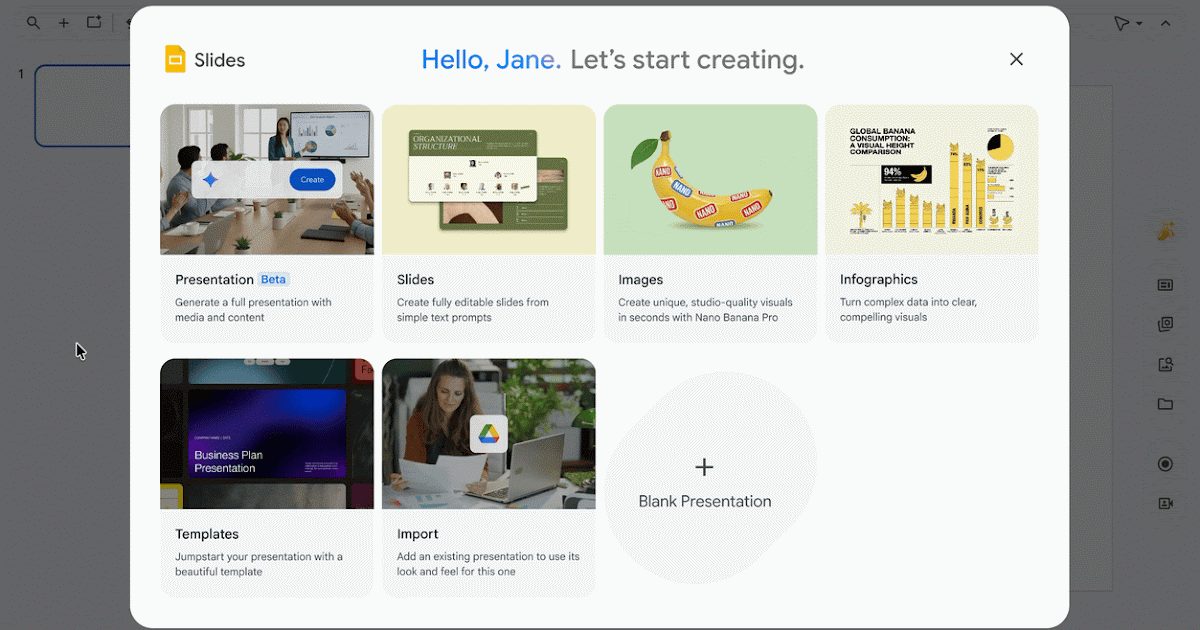
Gemini builds a whole presentation from the Slides side panel. You describe the deck, attach Drive files for it to work from, point it at an existing deck whose look it should copy, answer a few follow-up questions and approve the outline. What comes out is a normal Google Slides deck that colleagues can edit and comment on as always, and Gemini also suggests related files, emails and chats you might want it to use.
If your company already pays for Workspace Business Standard ($14 per user per month) or higher, this costs nothing extra, and that’s the main reason to choose it over Plus AI. Personal accounts need Google AI Pro at $19.99 a month; Business Starter and free accounts don’t get deck generation. It launched in US English only. Its designs are built from Slides’ own toolkit, so expect a tidy template look rather than Gamma’s polish.
What it does
- Generates a full deck in Google Slides from a prompt and attached Drive files
- Copies the style of a reference deck
- Lets you edit the outline before building
Pros
- Native, fully editable Slides output
- No extra cost on Workspace Business Standard and up
Cons
- Not on free accounts or Workspace Business Starter
- Launched in US English only
- Skip if:
- Your Google account is free or on Business Starter

Prezi
For talks that zoom instead of click
#9 3.1/5
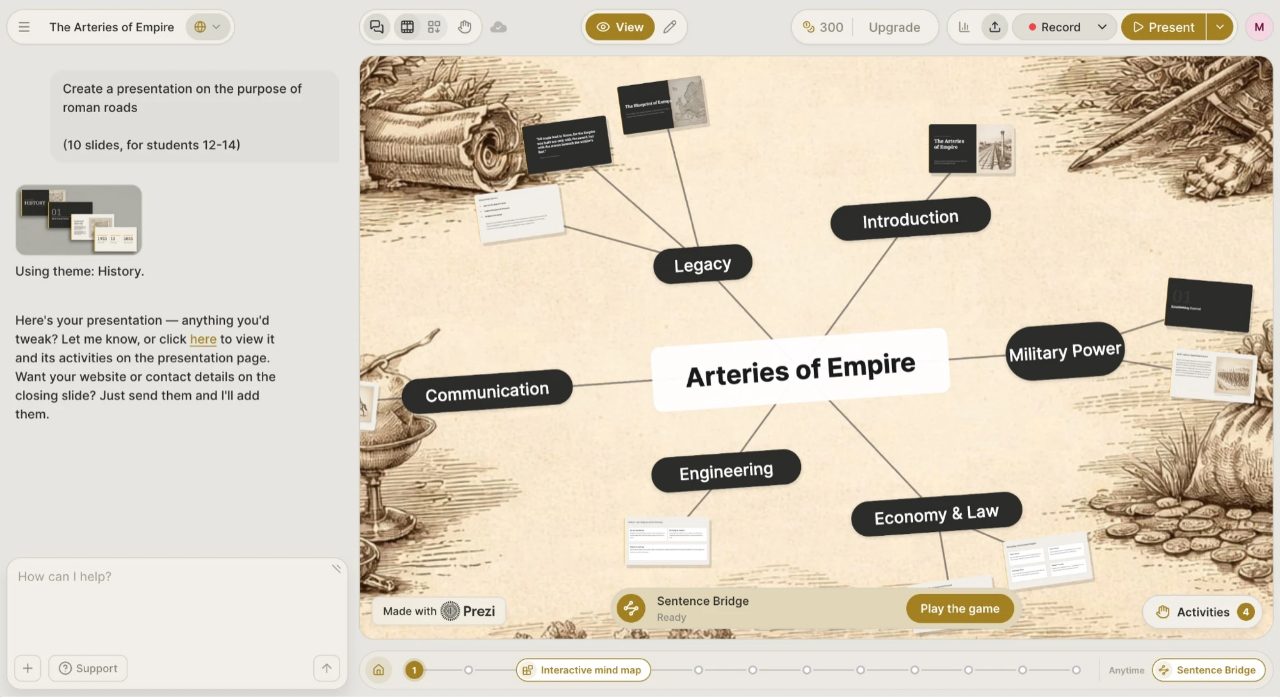
Prezi still does what nothing else here does: it puts your slides on one big canvas and flies between them, zooming into a detail and back out to the big picture. Prezi AI drafts the presentation from a conversation or an uploaded PowerPoint, PDF or Word file, and you can present it as zooming Prezi or as ordinary slides. For a keynote or a lesson where the overview matters, the motion helps people keep their place.
It also takes getting used to if you think in slides, and the swooping can be a lot for some audiences, so use it with restraint. The free plan’s presentations are public, unlimited AI generation needs the $19 Plus plan, and the zoom doesn’t survive a trip to PowerPoint.
What it does
- Zooming canvas, or classic slides when you present
- Builds from a conversation or uploaded PowerPoint, PDF and Word files
- Prezi Video presents beside your camera image
Pros
- Memorable for talks where the big picture matters
- Applies your brand from your guidelines or website
Cons
- Free presentations are public
- The canvas has a learning curve, and the motion can distract

ChatGPT
For outlines and speaker notes
#10 3.1/5
ChatGPT makes slides three ways, and which one you get depends on your plan. Asking in a chat gives you a .pptx file, but it tends to be plain text slides you then design yourself. The ChatGPT for PowerPoint add-in, available on every plan (Free and Go with limited use), works in a sidebar inside PowerPoint: it builds or revises slides in the open deck and tries to follow its template, though the result doesn’t always match a house style. ChatGPT Slides, a full deck editor with real-time co-editing, export to PowerPoint and Google Slides, and a present mode, is only on Pro, Business and Enterprise.
For a Plus subscriber ($20 a month), the add-in is the useful route, and it needs PowerPoint. Where ChatGPT shines is the thinking: shaping the story, cutting a long memo down to five slides, writing speaker notes, and asking what questions the audience will raise. If you want a deck that already looks designed, Claude’s free Slides tool or Gamma will get you further.
What it does
- ChatGPT for PowerPoint add-in on every plan
- ChatGPT Slides editor on Pro and business plans
- Builds from notes, documents and spreadsheets
Pros
- Strong at outlines, story structure and speaker notes
- The add-in edits real slides inside PowerPoint
Cons
- Slides from a chat are plain text with no design
- The designed Slides editor needs Pro or a business plan
How the ten compare
1–5 per criterion · select a score for its reasoning and any sources
| # | Product | Overall | How good the generated slides look , counts double | How good the outline and words are | Fixing the draft | Works with PowerPoint and Google Slides | What you get free | Price of a plan for regular use | Brand and team features | Presenting and sharing , counts half |
|---|---|---|---|---|---|---|---|---|---|---|
| 1 | Gamma | 4.2 | 5 | 4 | 5 | 3 | 3 | 5 | 4 | 4 |
| 2 | Canva | 3.9 | 4 | 2 | 5 | 3 | 4 | 4 | 5 | 4 |
| 3 | Copilot in PowerPoint | 3.7 | 3 | 4 | 5 | 5 | 1 | 5 | 4 | 3 |
| 4 | Beautiful.ai | 3.6 | 4 | 3 | 4 | 3 | 1 | 4 | 5 | 5 |
| 5 | Pitch | 3.6 | 4 | 3 | 4 | 2 | 2 | 4 | 5 | 5 |
| 6 | Claude | 3.5 | 4 | 4 | 4 | 4 | 4 | 3 | 2 | 2 |
| 7 | Plus AI | 3.5 | 3 | 4 | 4 | 5 | 1 | 4 | 4 | 3 |
| 8 | Gemini in Google Slides | 3.4 | 3 | 4 | 4 | 4 | 1 | 4 | 4 | 3 |
| 9 | Prezi | 3.1 | 4 | 3 | 3 | 2 | 2 | 3 | 3 | 4 |
| 10 | ChatGPT | 3.1 | 2 | 4 | 4 | 4 | 4 | 2 | 3 | 2 |
Equal displayed overall scores are ordered by the earlier criteria; a known score comes before an unknown score. Identical scores use alphabetical order.
×2 = counts double in the overall score, ×½ = counts half.
How each criterion is scored
How good the generated slides look
Counts double in the overall score: A better-looking first draft is the main thing readers want from an AI deck maker over their usual slide app.
Judged from reviewers' side-by-side tests and examples of decks the tool generates from a plain prompt, before anyone edits them: layout variety, typography, how well images and colors fit the topic, and whether slides are crowded. It scores the tool's own output in the form most readers use, not what a skilled designer could build in its editor.
- 5 Distinctive design that looks made for the topic, with layouts and images a designer would choose
- 4 Polished, varied layouts with fitting images; looks professionally designed
- 3 A clean, consistent theme with some layout variety and images; looks like a decent template
- 2 A basic theme with little layout variety; most slides are bullets and need design work
- 1 Plain text slides with no design applied
How good the outline and words are
Judged from reviewers' tests and users' reports: whether the generated deck tells a sensible story for its audience, whether the slide text is specific or generic filler, and how well it uses source material you give it. Invented figures are a risk with every tool and are not scored here.
- 5 Reads like a strong first draft from someone who knows the topic and the audience
- 4 A well-organized story with specific points that uses your material, needing light edits
- 3 A sensible structure and serviceable text that needs a normal editing pass
- 2 A usable structure, but shallow, generic text that needs heavy rewriting
- 1 Generic filler that needs rewriting almost entirely
Fixing the draft
How easily you can change what the AI made: manual control over text, images and layout, and AI edits aimed at one slide or element without regenerating the whole deck.
- 5 Free-form editing plus AI edits to a chosen slide or element and AI revisions across the whole deck
- 4 Full direct editing plus AI edits to a chosen slide
- 3 Full direct editing or targeted AI edits, but not both, or editing held back by a fixed layout system or a hard-to-learn format
- 2 Direct editing of text and images, but little layout control and no targeted AI edits
- 1 Changes mostly mean re-prompting or regenerating; little direct editing
Works with PowerPoint and Google Slides
How well the deck carries into PowerPoint or Google Slides as an ordinary, editable presentation: whether the tool builds natively in them or exports editable files, on which plans, and whether exported slides keep real layouts and placeholders (so you can restyle the deck from the slide master) or arrive as loose text boxes on blank slides.
- 5 Builds natively in PowerPoint or Google Slides using your own template's layouts and slide masters
- 4 Builds natively in PowerPoint or Google Slides, or exports to both with the deck's structure intact
- 3 Exports editable PowerPoint and Google Slides files, but slides land on blank layouts without placeholders
- 2 Export only on paid plans, or the format loses much of the deck in conversion
- 1 No PowerPoint or Google Slides export
What you get free
How much deck generation the free plan allows and whether you can take the deck elsewhere. A free trial that ends or needs a card is not a free plan.
- 5 Renewing free generation with no meaningful cap
- 4 An AI allowance that renews (monthly or on rolling limits), with export
- 3 A one-time AI allowance that includes PowerPoint export
- 2 A one-time AI allowance, with no PowerPoint export or with presentations that must be public
- 1 No free way to generate decks; trial only, or a paid plan is required
Price of a plan for regular use
Price per person per month, at annual billing where offered, of the cheapest plan one person can buy that makes AI decks regularly rather than under a "limited" free allowance. A euro price is compared at face value. Where the plan is a bundle (such as Microsoft 365 or Google Workspace), the bundle's price counts.
- 5 Under 10 a month
- 4 10 to 14.99 a month
- 3 15 to 19.99 a month
- 2 20 to 29.99 a month
- 1 30 or more a month
Brand and team features
Counts what lets a team keep decks on brand and work on them together: a brand theme or company template the AI uses, real-time co-editing, shared libraries of templates, slides or assets, and admin controls that lock brand elements. Features on any plan count.
- 5 All of 4, plus admin controls that lock brand elements or approve decks
- 4 All of 3, plus shared team libraries of templates, slides or assets
- 3 A brand theme or company template the AI uses, and real-time co-editing
- 2 Either a brand theme or company template, or real-time co-editing
- 1 Neither a brand theme nor real-time co-editing
Presenting and sharing
Counts half in the overall score: Matters mainly to sales and client-facing readers; most readers present in a meeting or send a file.
What the tool offers for presenting and sending the deck itself: present mode, share links with access control, and analytics on who viewed the deck and which slides they spent time on.
- 5 All of 3, plus slide-by-slide engagement tracking per link or viewer
- 4 All of 3, plus viewer analytics on some plan
- 3 Present from the app and share links with access control
- 2 Present from the app, or share a view link, but not both with access control
- 1 No way to present or share except exporting a file
Frequently asked questions
Will an AI presentation maker make up facts?
It can. Any of these tools will produce plausible statistics, quotes or market sizes if you ask for numbers it doesn’t have. Give it your own documents to build from, and check every figure before the deck goes out.
Will my slides be used to train AI?
It depends on the plan. Gamma excludes Business and Enterprise workspaces from AI training, but on its individual plans your content may be used unless you opt out in settings. Google Workspace business data isn’t used to train Google’s models, and ChatGPT’s individual plans use your content for training by default, with an opt-out. Check the data setting on the plan you buy before you upload anything confidential.